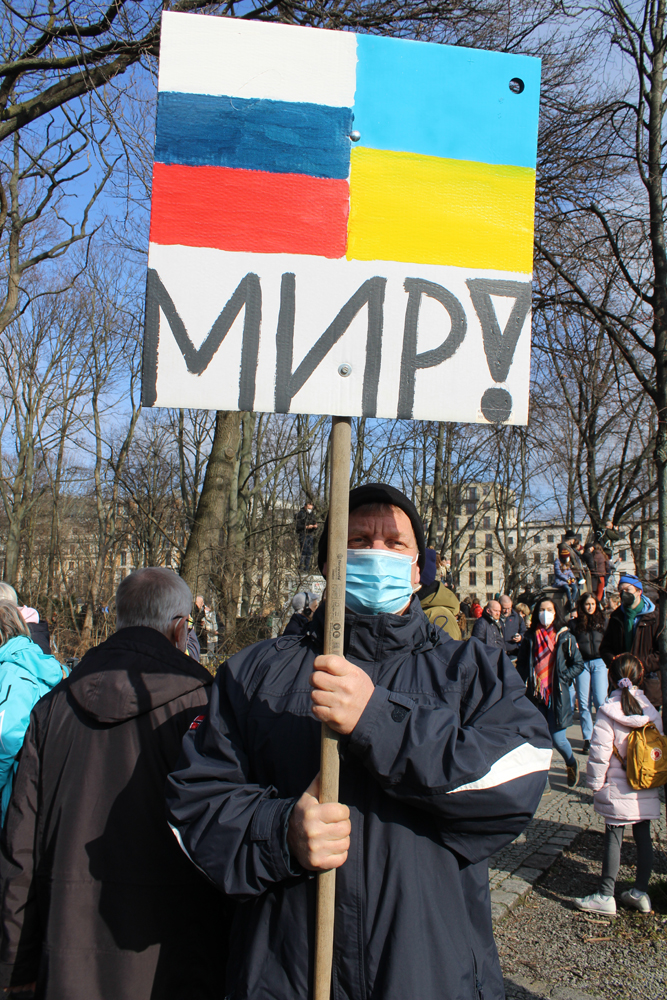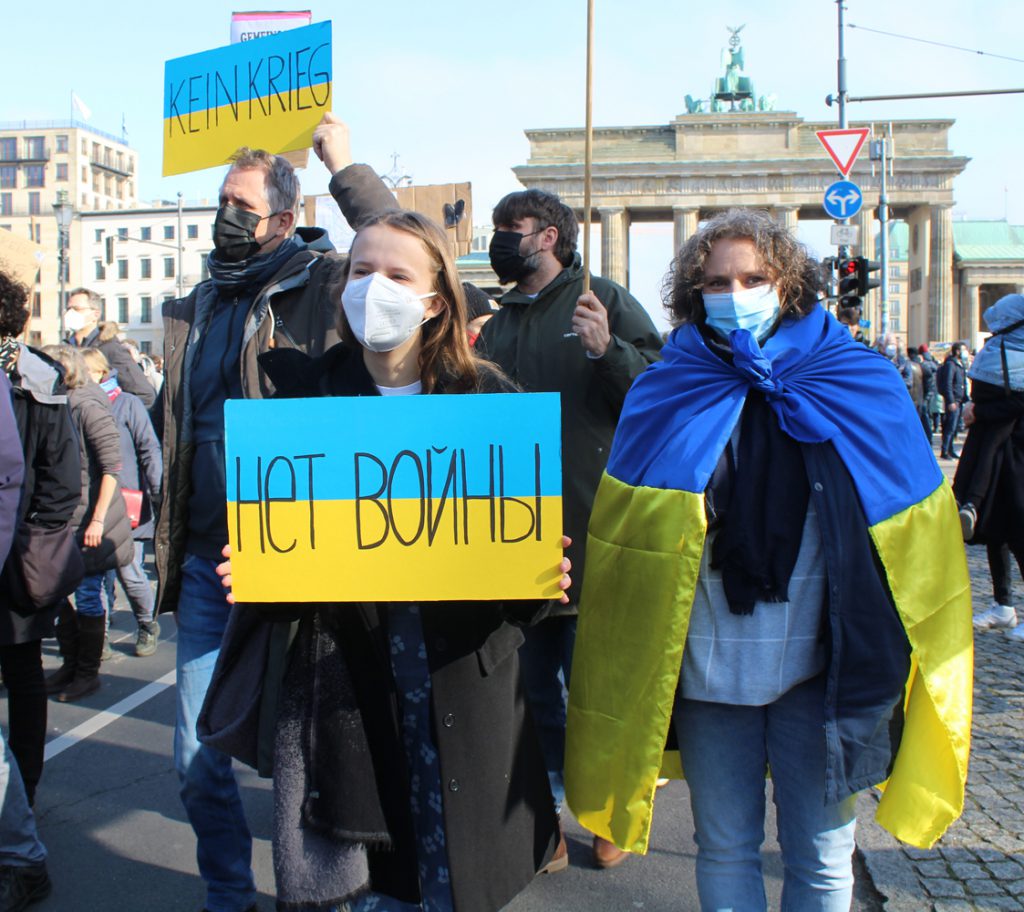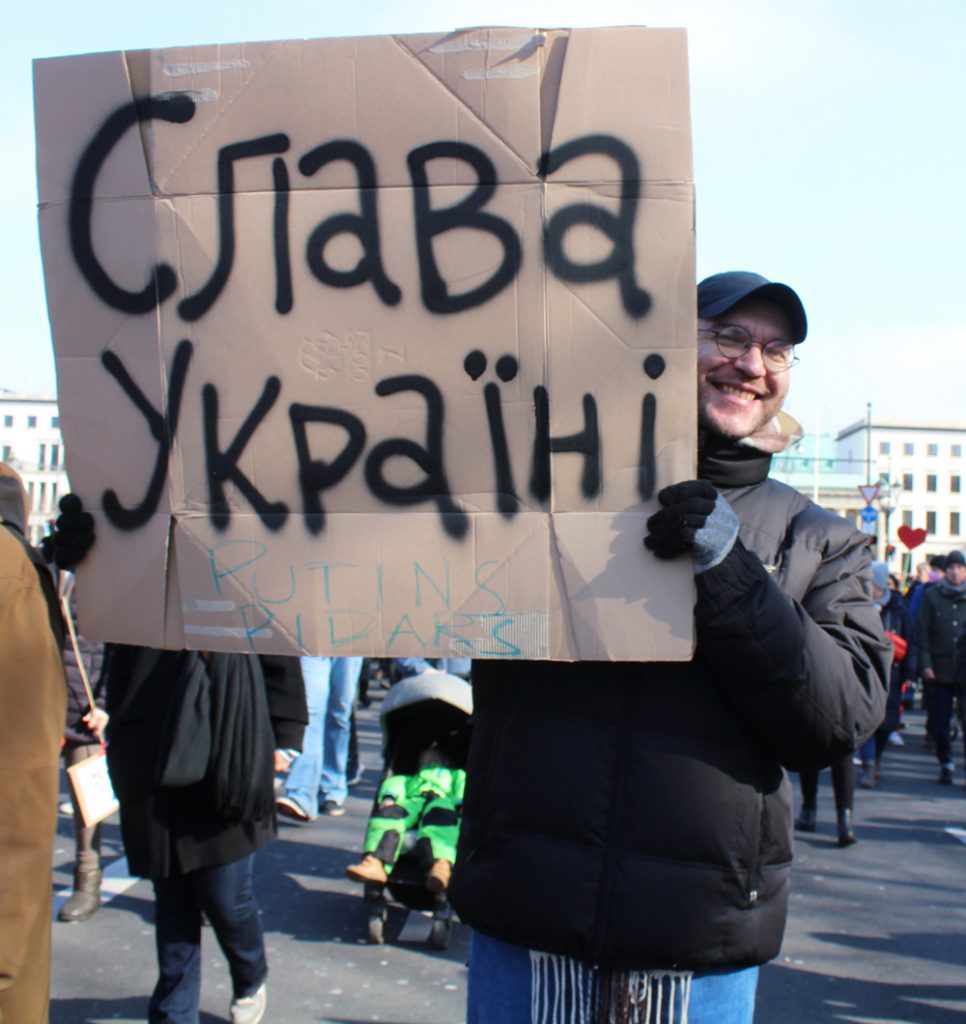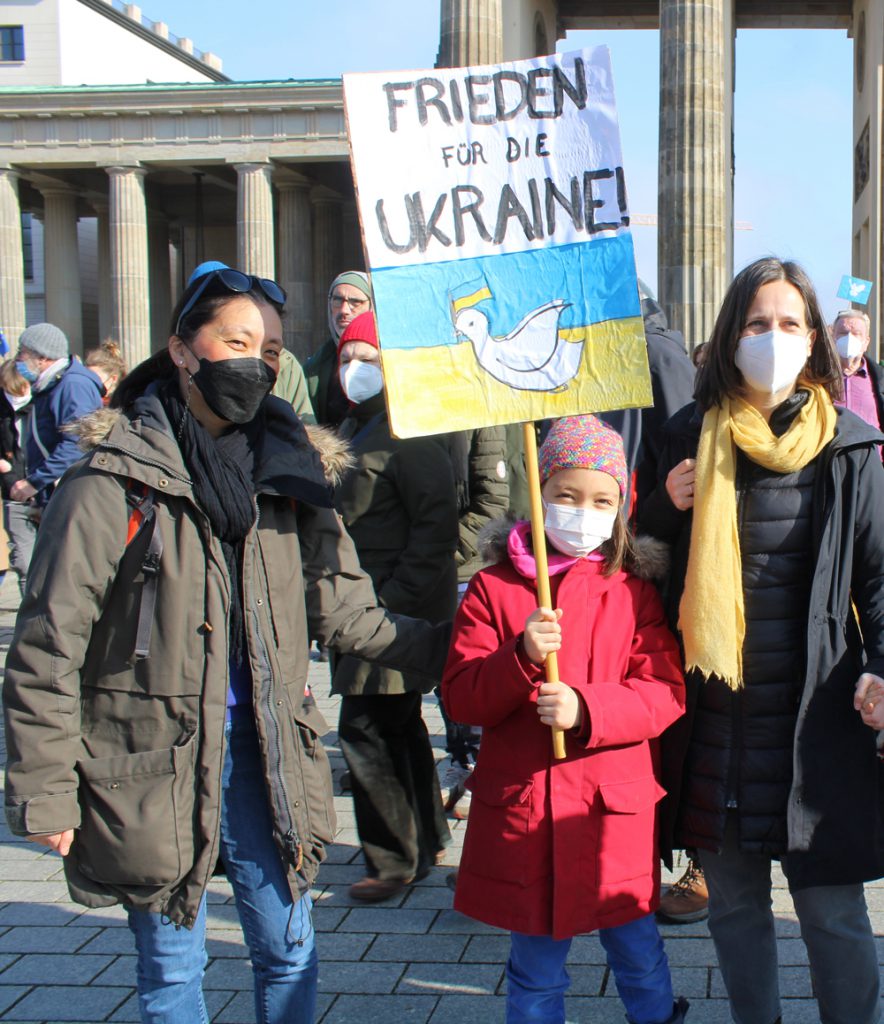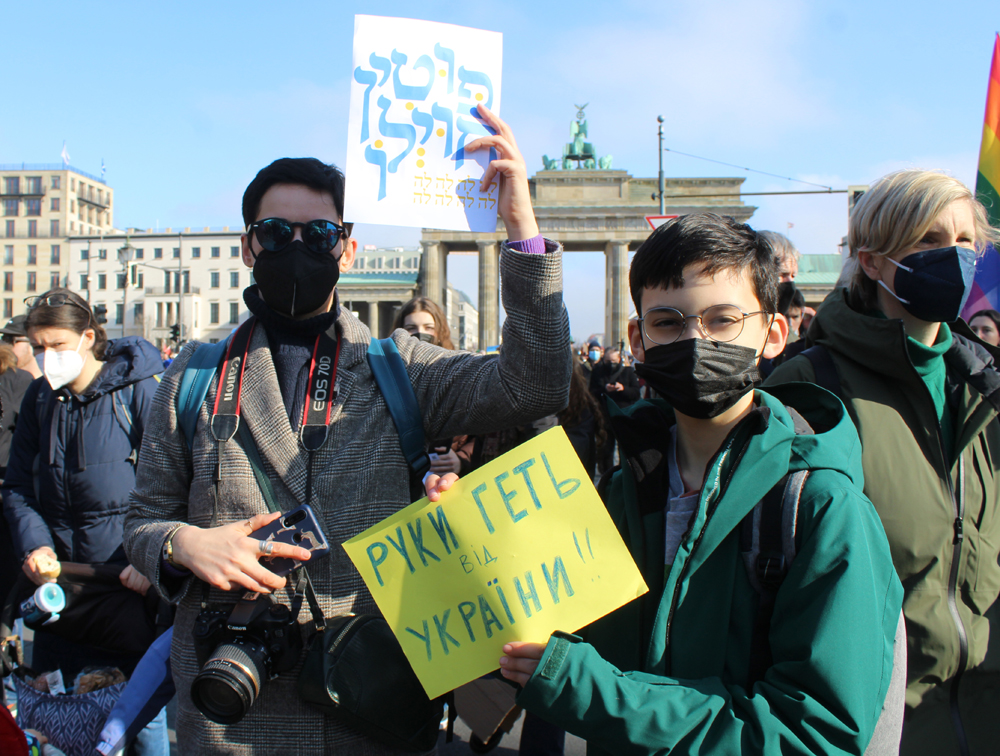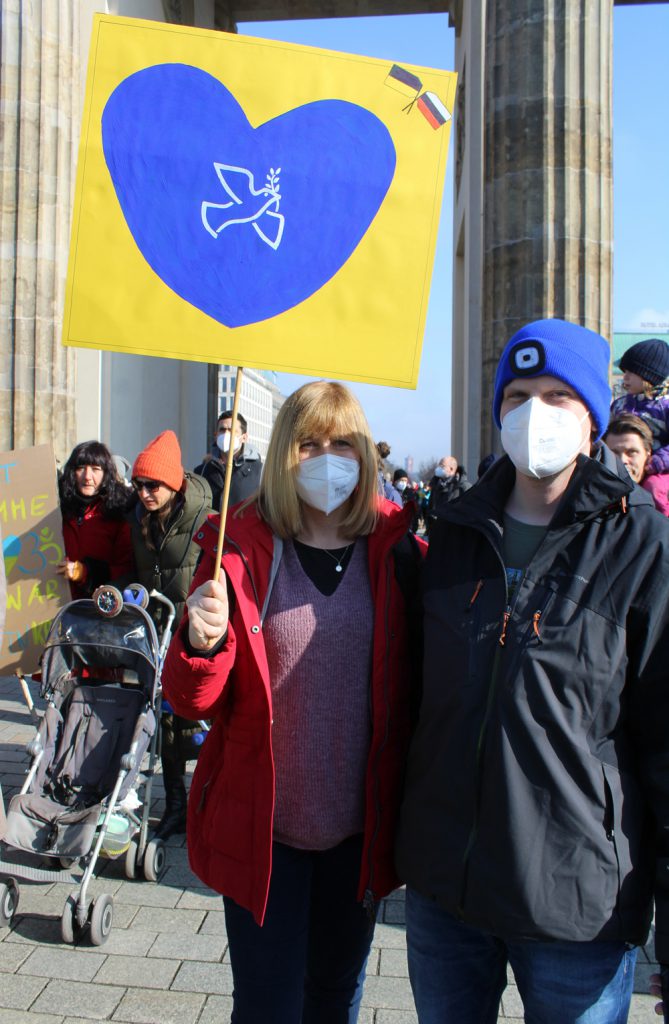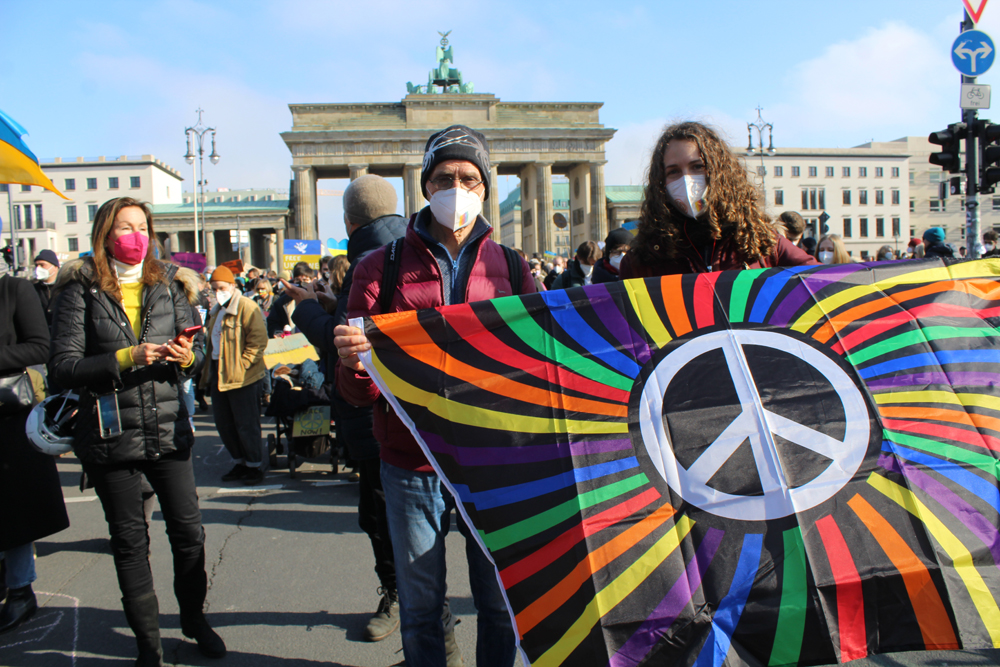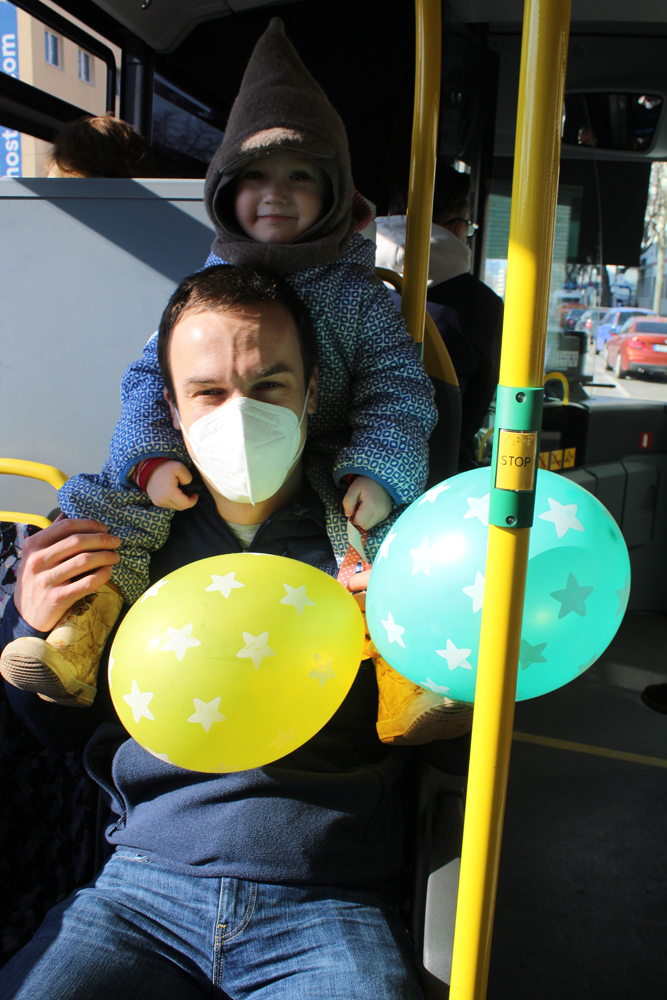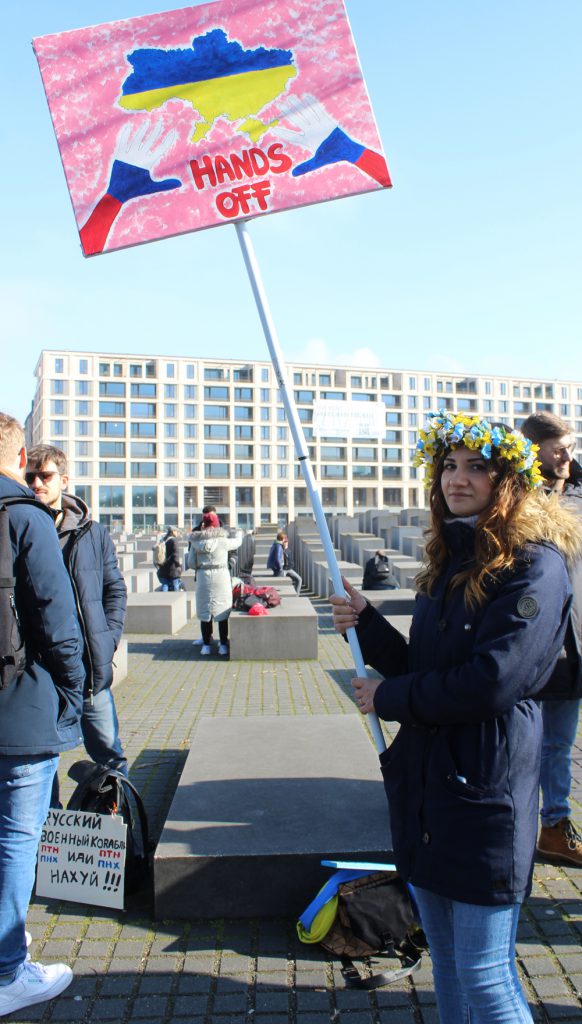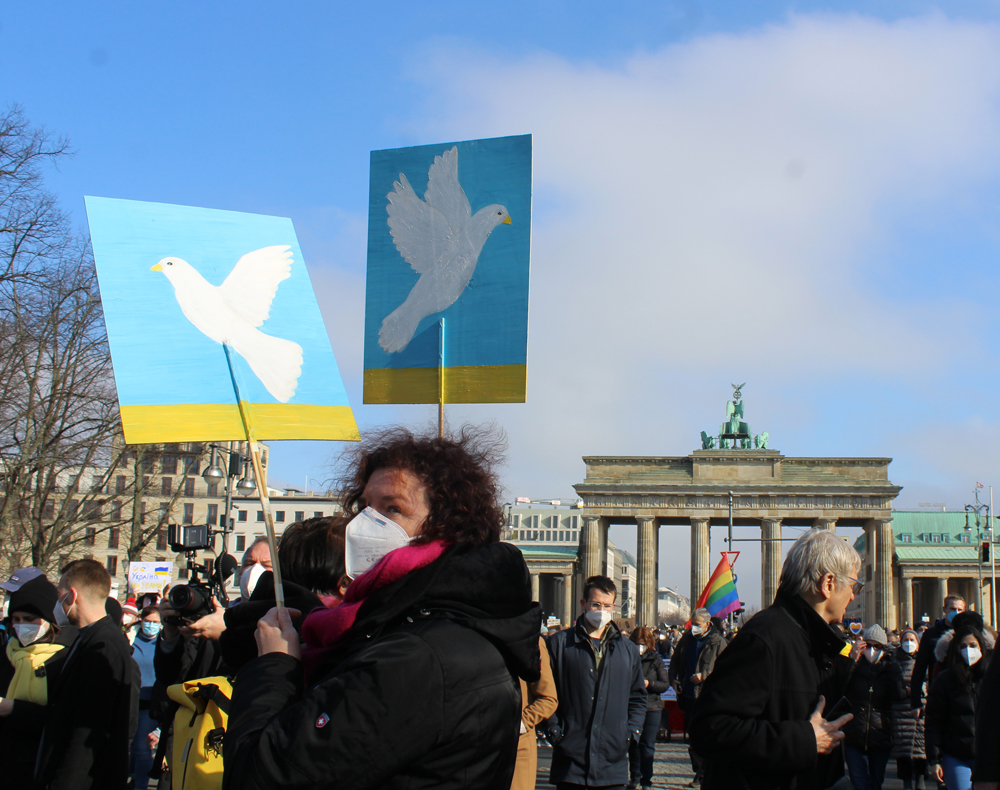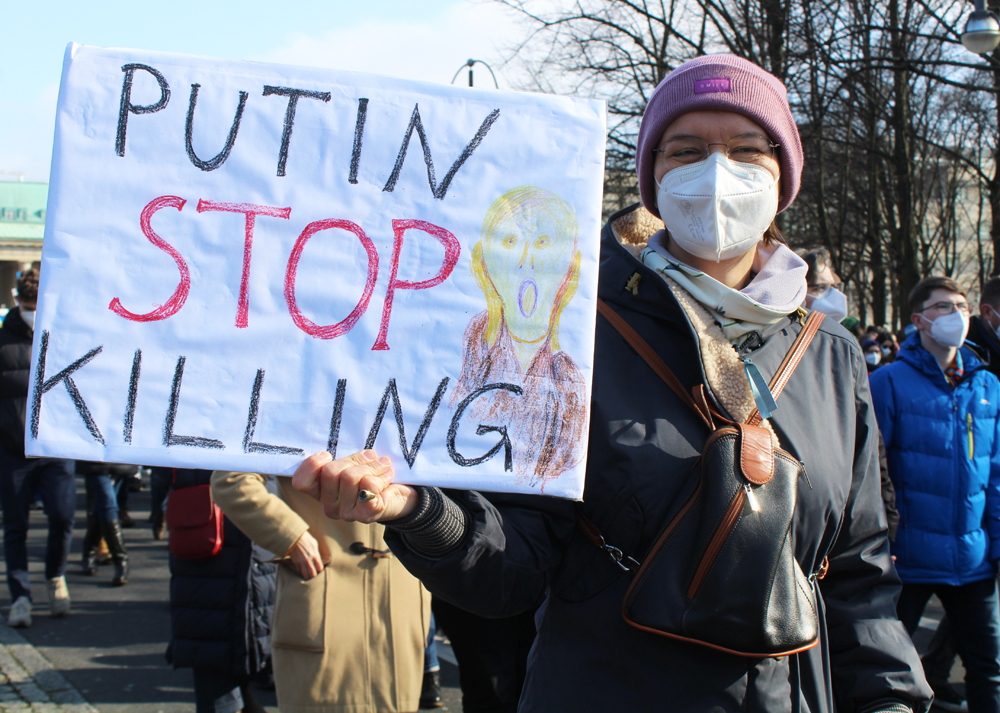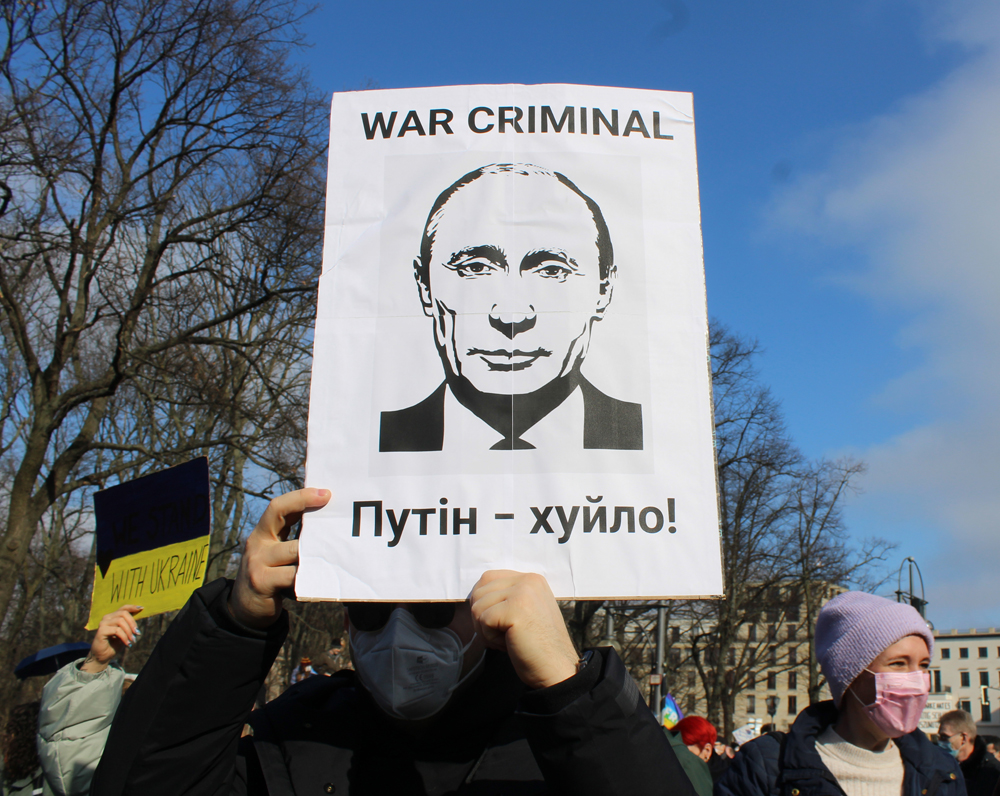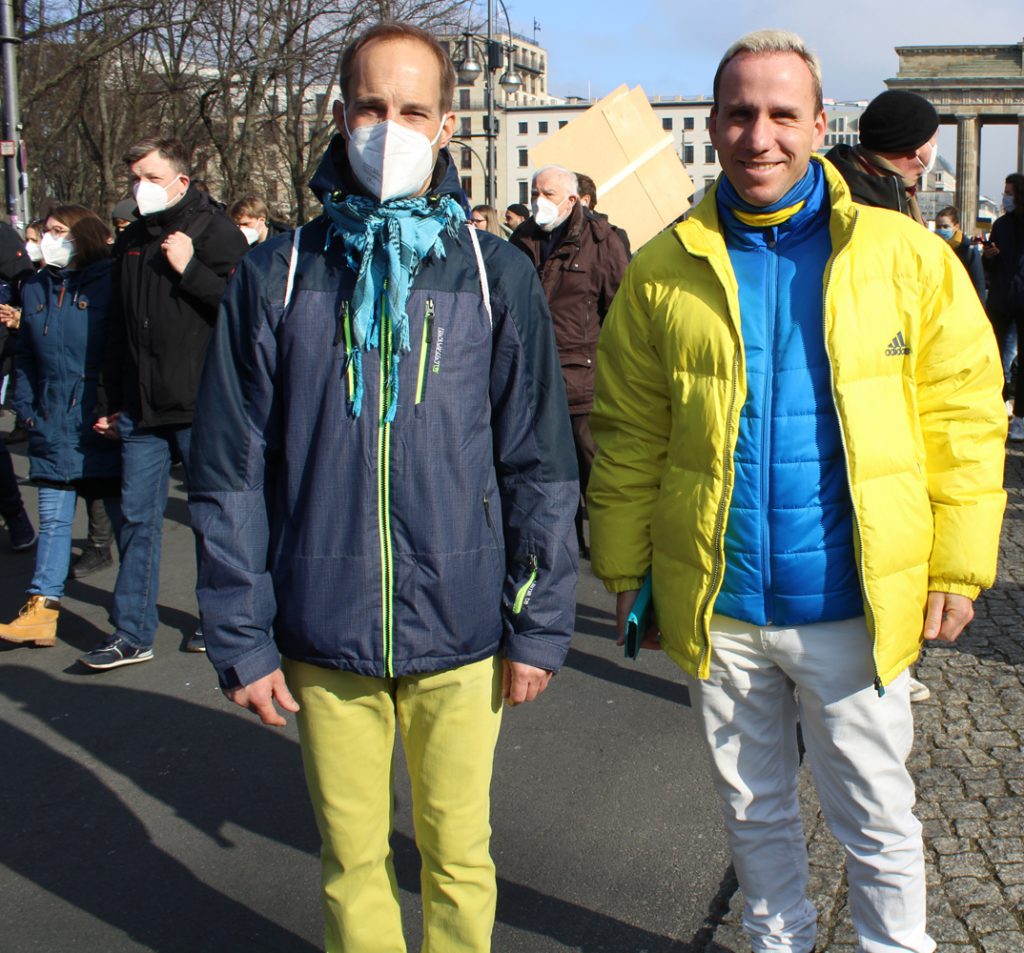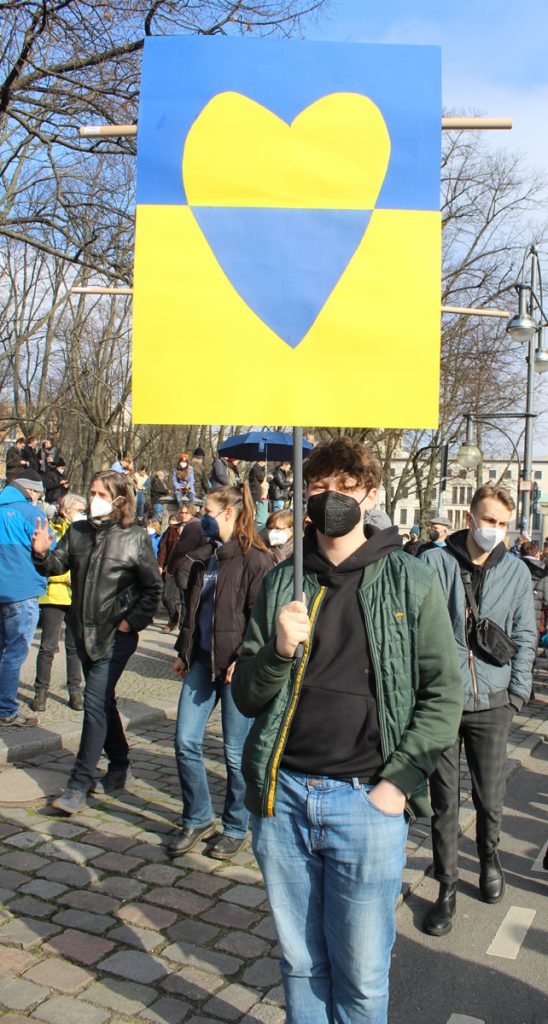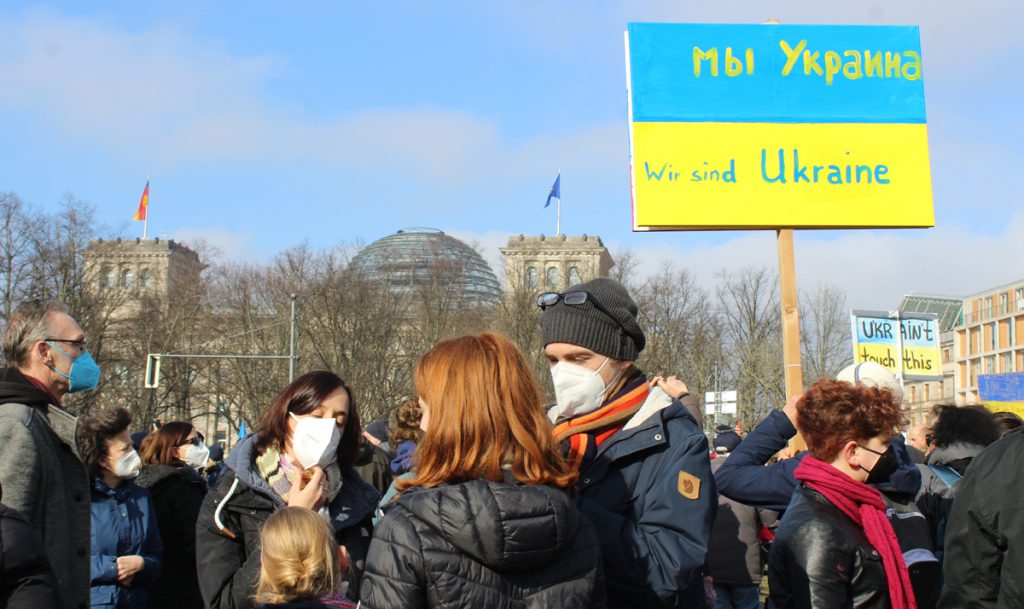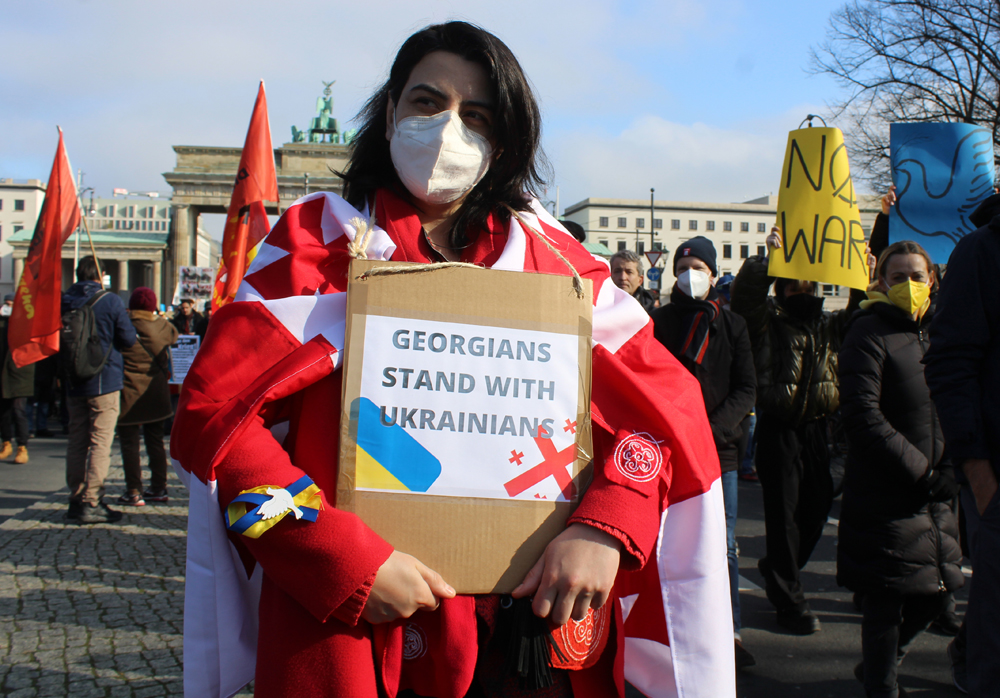

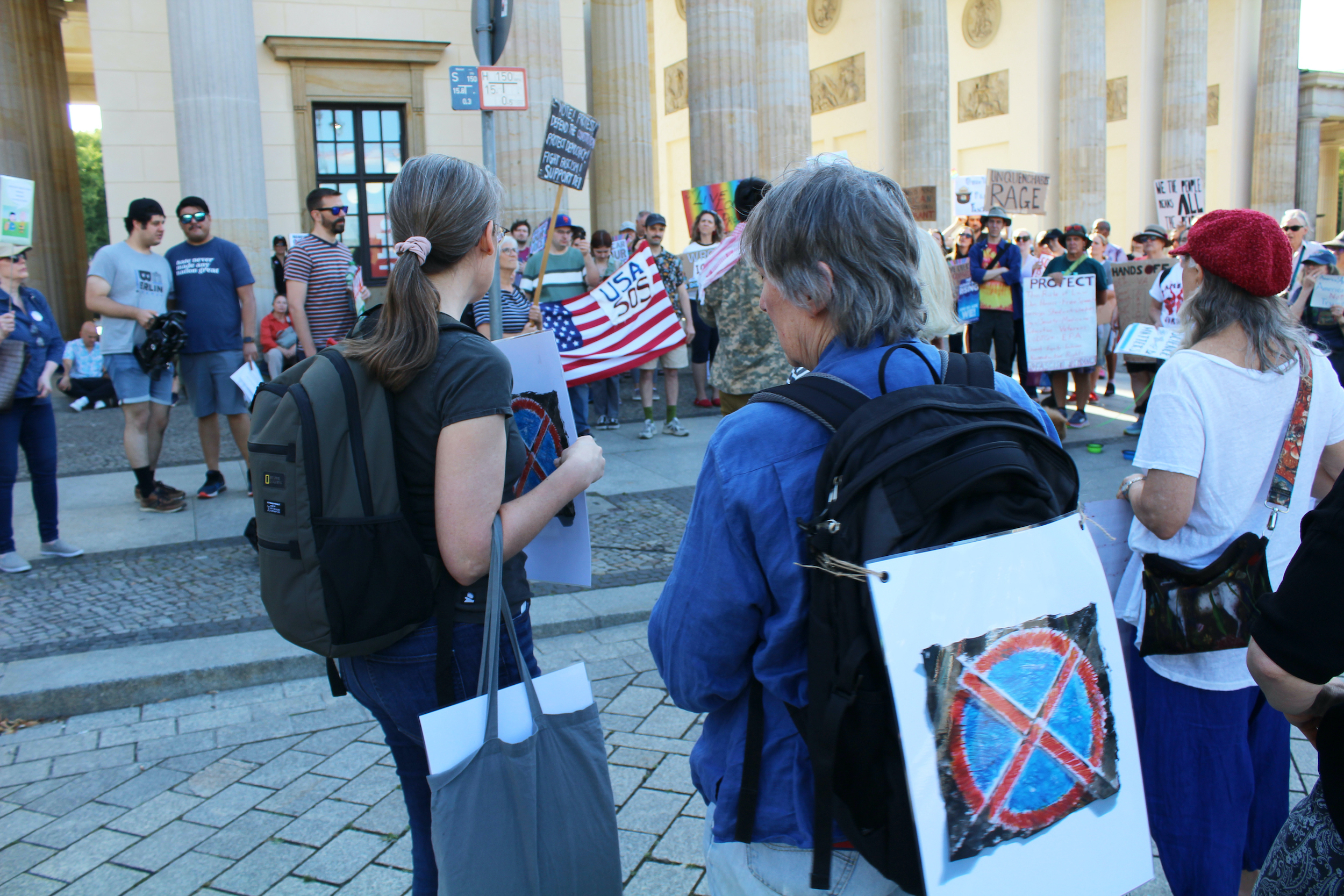
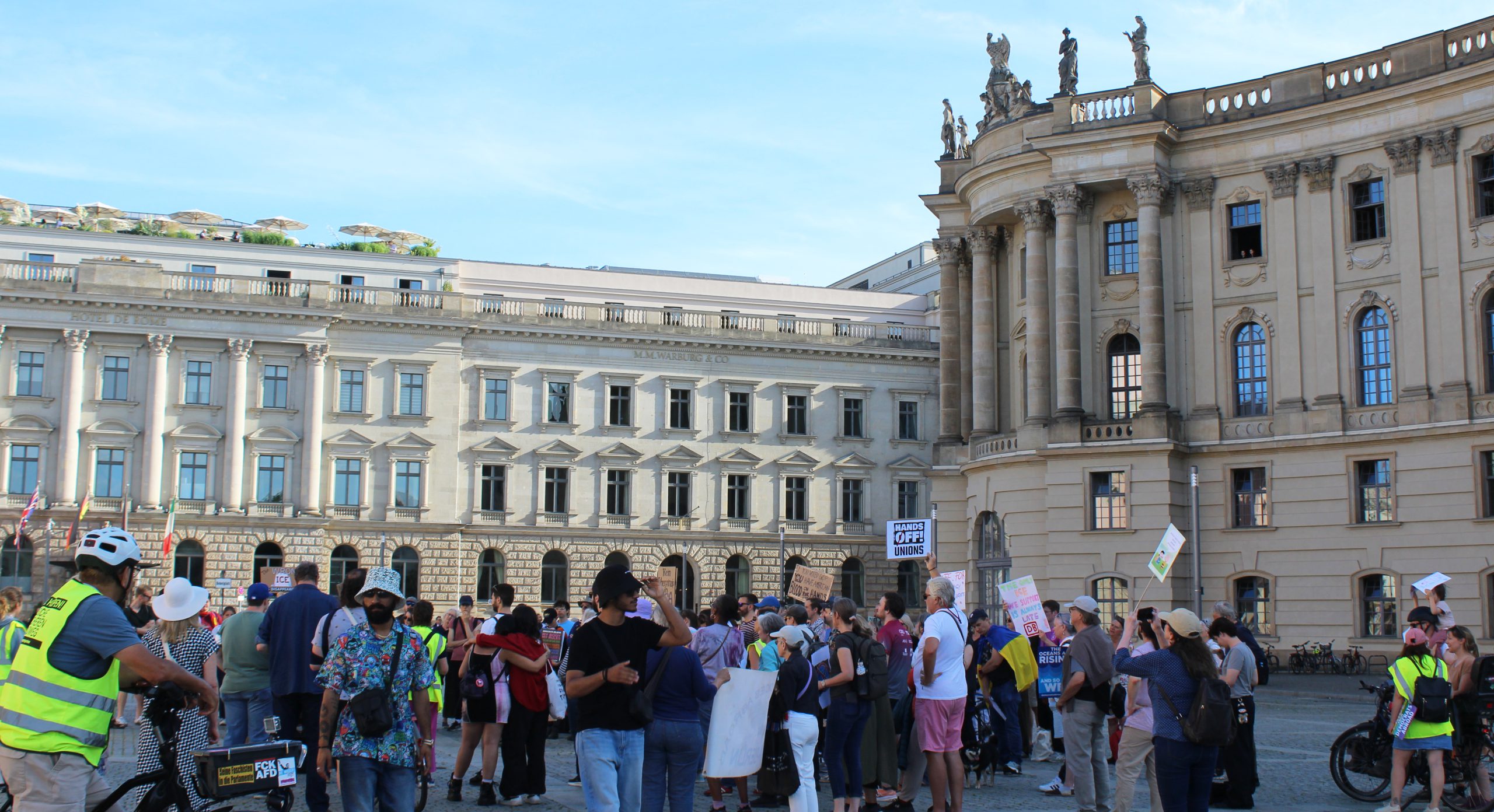
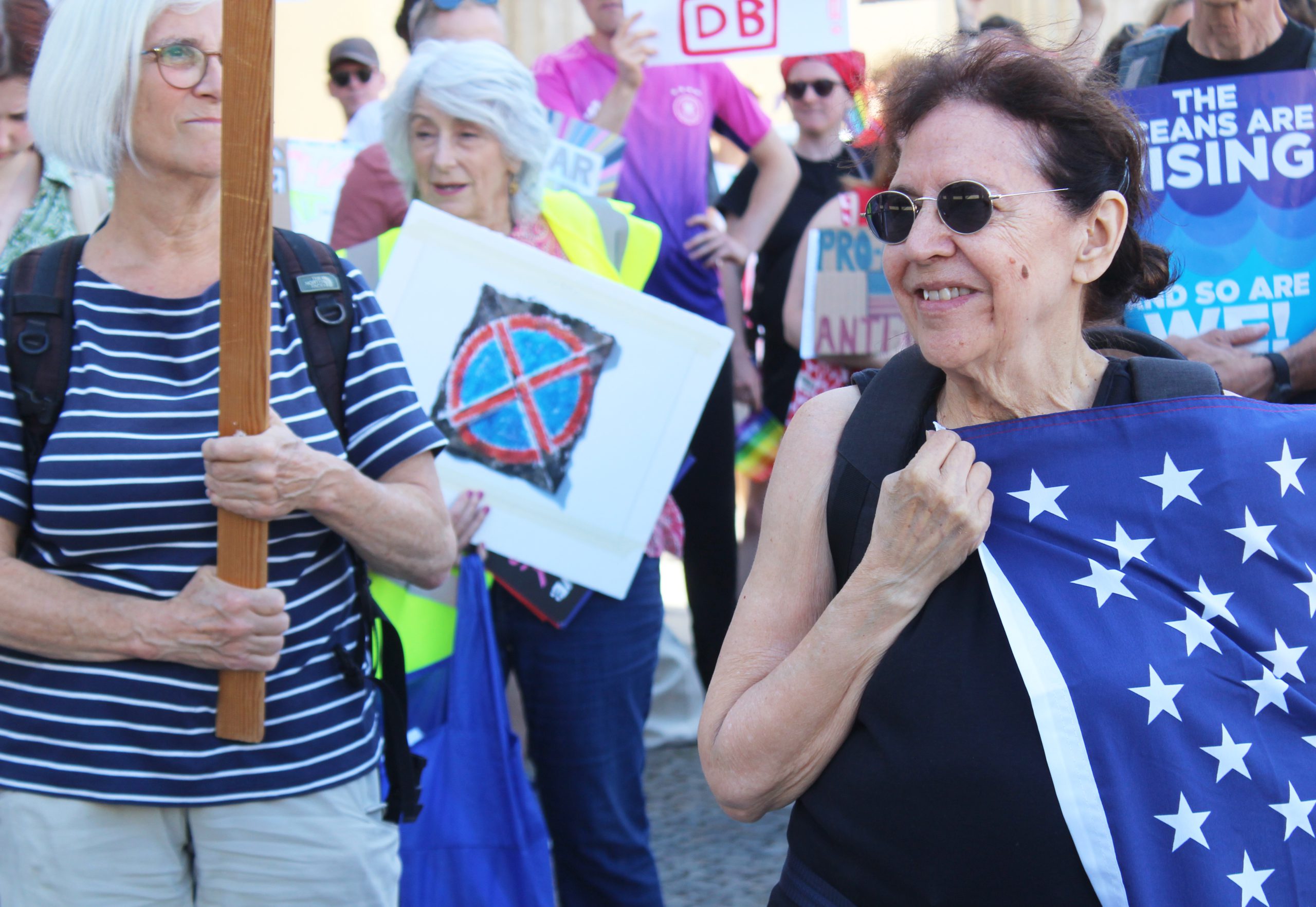
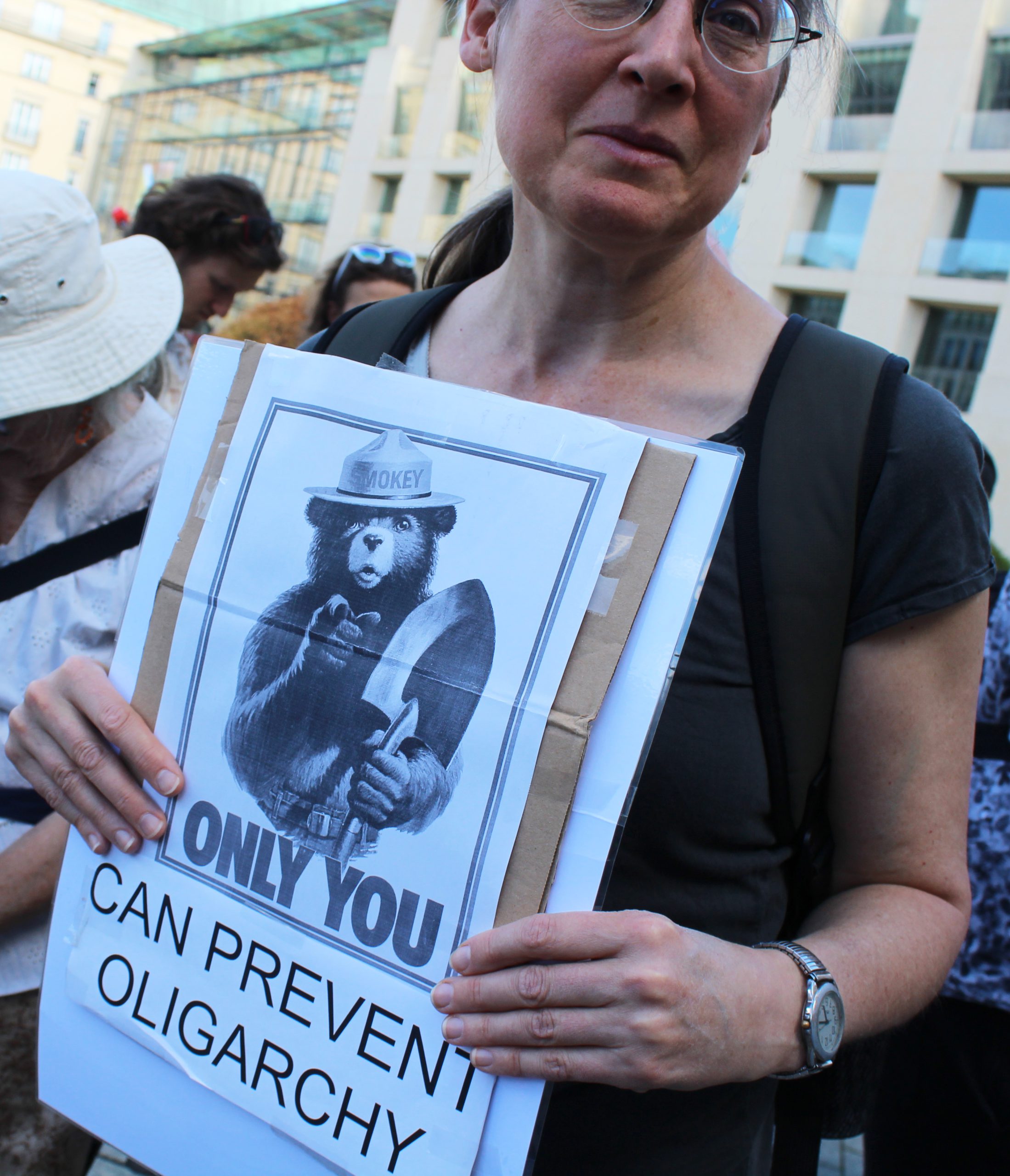
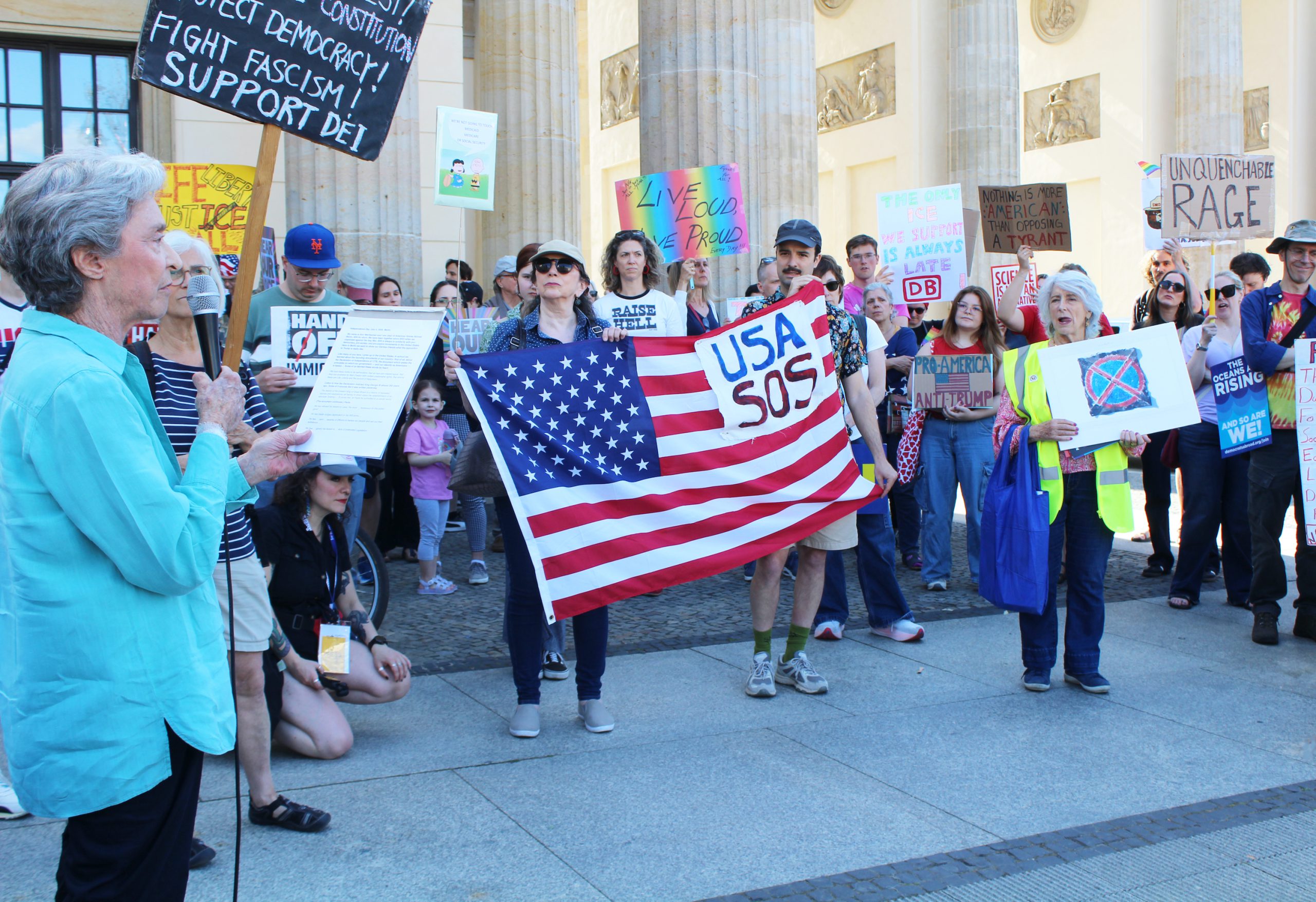
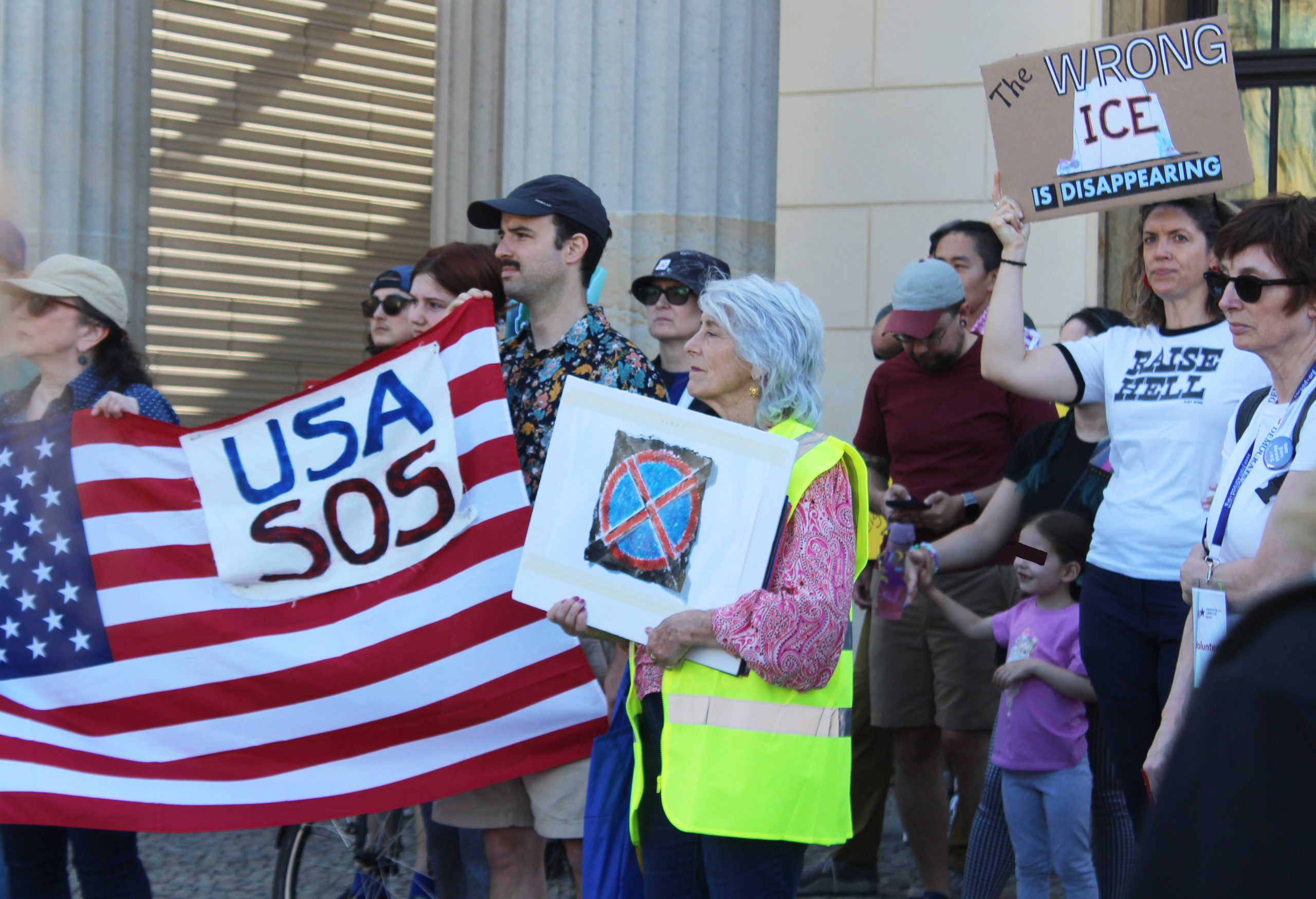
Democrats Abroad Berlin (DA) Berlin organized a July 4th protest in front of the U.S. Embassy at Pariser Platz. An American Voices Abroad Berlin (AVA) contingent joined them there and then about 200 of us walked down Unter den Linden to Bebelplatz to the site of the 1933 Nazi book burnings. See the Abendschau (Nachrichten I) coverage below.
https://www.rbb-online.de/abendschau/videos/20250704_1930.html
In the video below, Eva Adams sings her own composition to protest the corruption and cruelty of the Trump administration.

The plan is to meet at Pariser Platz at 5 pm on Friday, July 4th, then to march from Pariser Platz to Bebelplatz (site of the bookburning memorial).
(Scroll down to read speeches and see videos from the demonstration.)
I want to say a few words about one of the underlying factors in our current catastrophe: the political repercussions of tech monopolies.
Amid ever-new and escalating crises – LA, Iran – it is easy to lose sight of underlying problems that have become normalized. As the need to mobilize becomes more and more urgent, it is – understandably – tempting to postpone a reckoning with the technical tools we use to communicate and organize, or simply to cope with our everyday life.
And with Elon Musk’s political influence (ostensibly) on the wane, and Trump’s trade wars actually harming some of the interests of the tech oligarchy, it is understandably tempting to hope that Trump’s Big Tech honeymoon is over and we can turn our attention to other matters. But whether or not Musk and Trump “get divorced”, “the whole government has become DOGE now”, as the tech magazine Wired writes. It is still mining our data for unknown purposes and fantasizing about replacing civil servants with AI.
(more…)(Scroll down to read two additional speeches given at the NO Kings demonstration.)
My name is Ann Wertheimer and I am chair of American Voices Abroad Berlin, AVA for short. We have been together since 2003 when we organized against the Iraq War. Like many of you here, I grew up in the United States. In school we learned about the founding documents of our country: first of all, about the Declaration of Independence of 1776, the document which states the principles on which our government — and our identity as Americans — is based…. Some of us learned these words by heart:
We hold these truths to be self-evident, that all men are created equal, that they are endowed by their Creator with certain unalienable rights, that among these are Life, Liberty and the pursuit of Happiness….
Listen to how the Declaration indicted King George III almost 250 years ago. Some of it sounds like it was written yesterday.
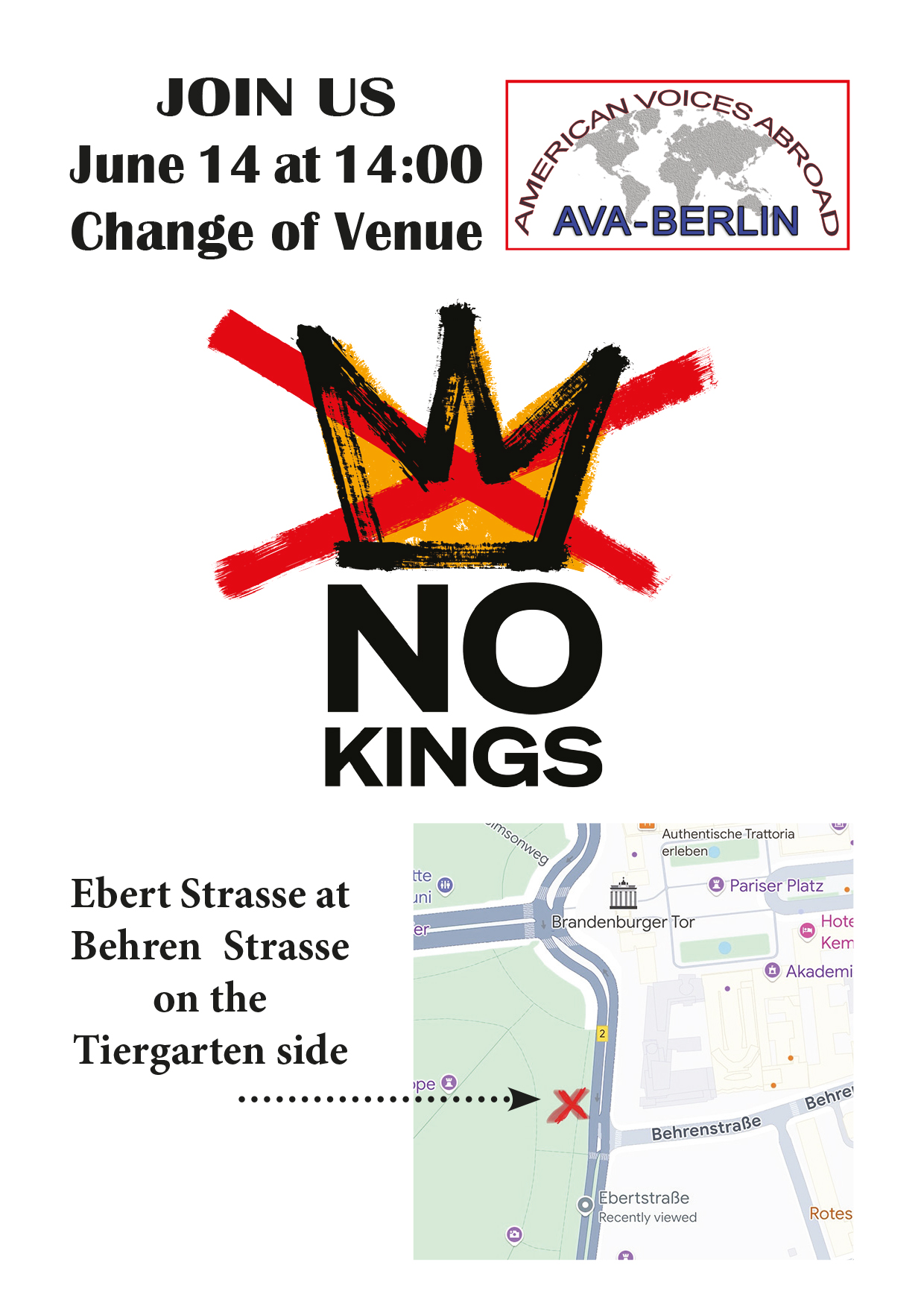
(more…)Because of overcrowding, the Polizei have just changed our location to Ebert Strasse at Behren Strasse on the Tiergarten side of the street. This is behind the U.S. Embassy and across Ebert. It’s actually a good location, but very late to be notified. The police officer said: Es ist viel los in Berlin.
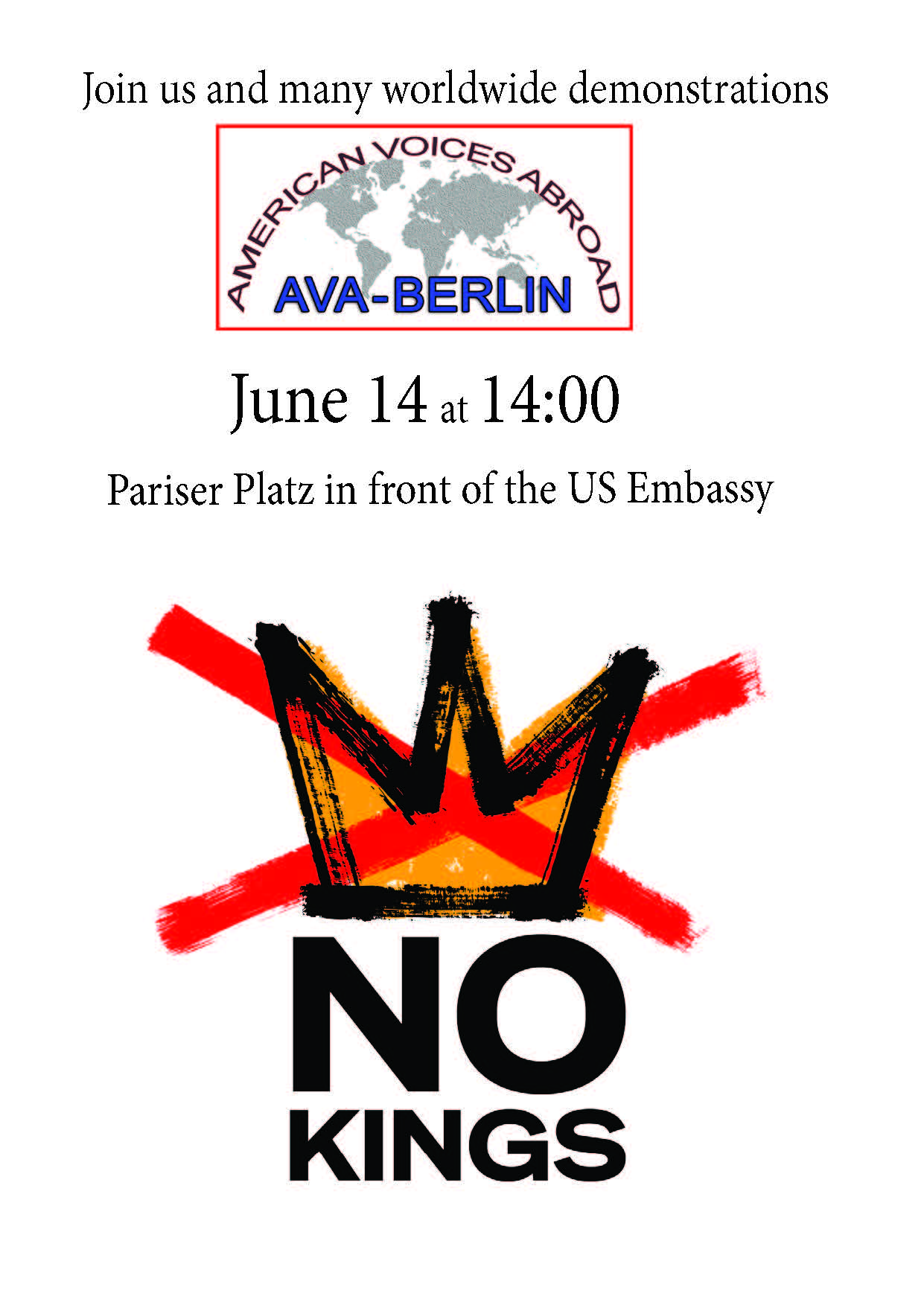
Everything else stays the same. We meet at 2:00 PM on Saturday. Look for our info table and the AVA banner. I’ll do an introduction and then there will be three speakers: Susan Neiman, Isabel Fargo Cole, and Richard Peterson. Then we can meet around the info table and talk.
Ann Wertheimer, chair
American Voices Abroad Berlin
Video of Ann Wertheimer’s speech.
My name is Ann Wertheimer and I am chair of American Voices Abroad Berlin. Our group has been together since we organized against the Iraq War in 2003.
My parents were refugees from Nazi Germany. They were able to leave in 1936 and 1937 and settled first in New York City and then in the New Jersey countryside where they started a farm. That’s where I was born and grew up. I have both American and German citizenship.
I came to Berlin in 1971 to teach at the Kennedy School in Zehlendorf. I thought I was coming for a year or two, but now it’s been almost 54 years.
I still vote by mail in New Jersey, where I have two good Senators, both Democrats. One Senator is Andy Kim. In 2018, Kim was elected to the House of Representatives, and in 2024 he was elected to the Senate, becoming the first Korean-American United States Senator.
(more…)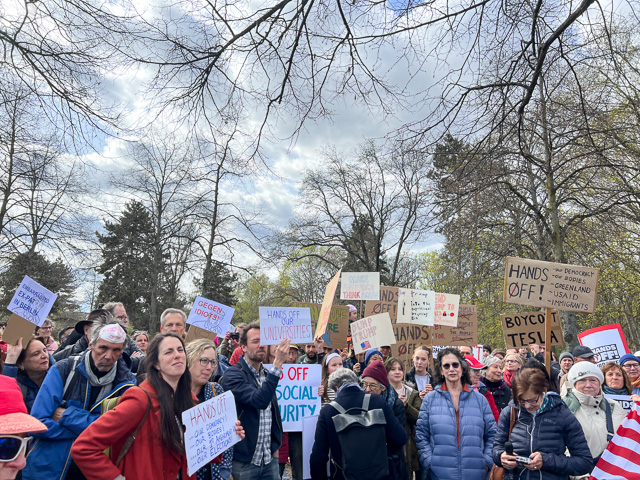
Hands Off
This Saturday, decentralized Hands Off! demonstrations are taking place all over the United States as well as a few other places around the world, including here in Berlin:
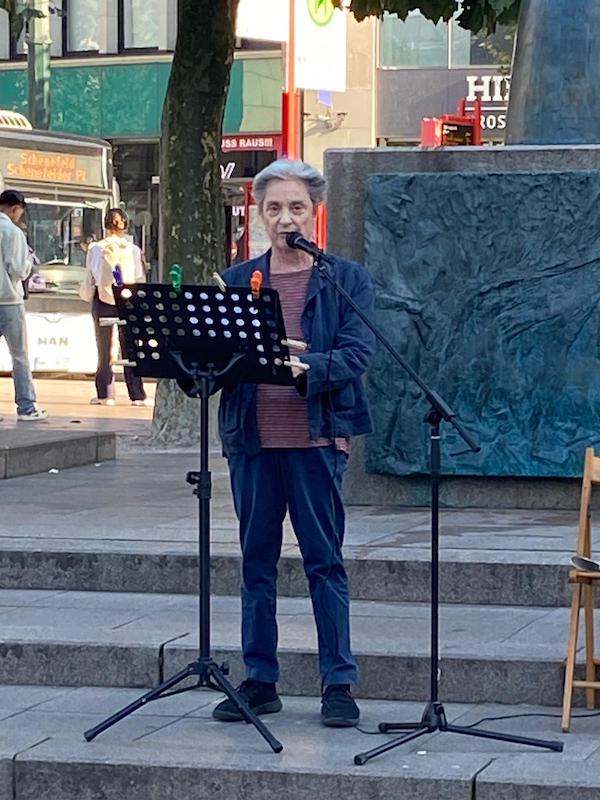
The following speech was given by AVA-Berlin Chair Ann Wertheimer on September 22, 2024 in Hamburg at a rally to defend democracy.
My name is Ann Wertheimer. I was born in New Jersey and
lived there until I moved to Washington, D.C. to work as a public
school teacher. I have been living in Berlin since 1971 where I
taught English at the Freie Universität.
I am the chair of American Voices Abroad Berlin—or AVA, for
short. AVA is a politically progressive group independent of all
political parties both in the United States and in Germany. We
offer a community for engaged U.S. citizens and provide a
forum for a wide spectrum of views. We began in 2003 as
Americans in Berlin Against the Iraq War. After a while, we
began to focus on other issues and then changed our name.
And, by the way, we are not only citizens of the United States;
we are also members of the community where we live. We seek
to engage all members of this community in dialogue on issues
of mutual concern. (more…)
Her good advice seemed to provide appropriate answers to questions that are sometimes posed about the reasons for voting, so we have matched a few of those questions with quotes from her speech.
Link to the full text—
Some people ask: What is at stake in this election? What if I don’t identify with either of the major parties?
“Look, I don’t care how you identify politically, whether you are Democrat, Republican, independent or none of the above. This is our time to stand up for what we know in our hearts is right.To stand up not just for our basic freedoms, but for decency and humanity. For basic respect, dignity and empathy. For the values at the very foundation of this democracy.”
— Michelle Obama, speaking at the Democratic National Convention on August 20, 2024
Some people ask: Does my one vote really matter? Will it even be counted?
“This election is going to be close. In some states, just a handful — listen to me — a handful of votes in every precinct could decide the winner. So we need to vote in numbers that erase any doubt. We need to overwhelm any effort to suppress us. Our fate is in our hands. In 77 days, we have the power to turn our country away from the fear, division and smallness of the past.”
— Michelle Obama, speaking at the Democratic National Convention on August 20, 2024
Some people ask: What about the gerrymandering, the lies and dirty tricks? . What about the polls?
“ . . . . the minute something goes wrong, the minute a lie takes hold, folks, we cannot start wringing our hands . . . So if they lie about her, and they will, we’ve got to do something. If we see a bad poll, and we will, we’ve got to put down that phone, and do something. If we start feeling tired, if we start feeling that dread creeping back in, we’ve got to pick ourselves up, throw water on our face, and what?” [Crowd chants back, “Do Something!]
— Michelle Obama, speaking at the Democratic National Convention on August 20, 2024
Some people say: She’s too far left/she’s too far right/she’s too much in the middle/ She’s not the candidate I most wanted. She’s not clearly on the same side as I am on every issue. I’m afraid most Americans will not vote for her.
“We cannot get a goldilocks complex about whether everything is just right. And we cannot indulge our anxieties about whether this country will elect someone like Kamala, instead of doing everything we can to get someone like Kamala elected.”
“It’s up to us to remember what Kamala’s mother told her: Don’t just sit around and complain, do something.”
— Michelle Obama, speaking at the Democratic National Convention on August 20, 2024
Some people say: Nobody has come knocking on my door to ask for my vote. They don’t care about it. Why should I bother?
“We only have two and a half months, y’all, to get this done. Only 11 weeks to make sure every single person we know is registered and has a voting plan. So we cannot afford for anyone, anyone, anyone in America to sit on their hands and wait to be called. Don’t complain if no one from the campaign has specifically reached out to you to ask you for your support. There is simply no time for that kind of foolishness. You know what you need to do. So consider this to be your official ask. Michelle Obama is asking you — no, I’m telling y’all — to do something.”
— Michelle Obama, speaking at the Democratic National Convention on August 20, 2024
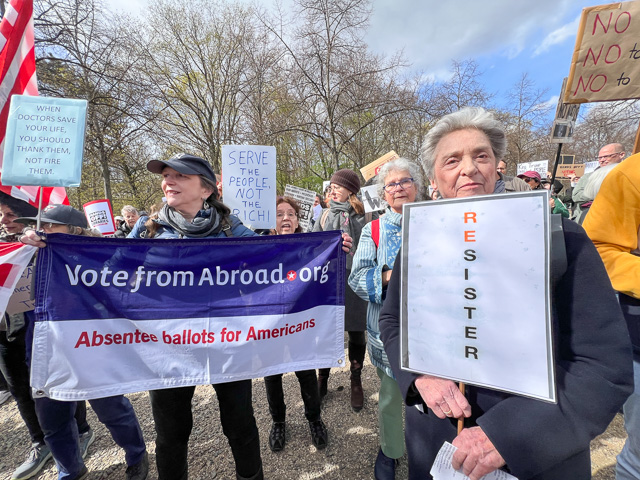
Did you know that American citizens who live abroad—whether traveling, working, or studying; whether temporarily or indefinitely living abroad—are eligible to vote as overseas voters? This is true if you are just now turning 18 and living abroad, or if you’ve been living abroad for many years and have never voted before, or if you’ve been exercising this right for many years.
Basically there are three steps involved: 1) registering and requesting a ballot; 2) filling out the ballot form to vote; 3) returning your ballot to the registration office in time for your vote to be counted. Some states require the ballot to be sent by post; others allow for it to be sent by email.
You can obtain more specific information about the process in your state at one of the following websites:
www.overseasvotefoundation.org
is a non-partisan site with a good and easy database for finding and contacting your registration office.
www.votefromabroad.org
is from the Democratic Party. Application for membership is an option, but they provide information to anyone who requests it.
www.fvap.gov
connects you to the U.S. government’s Federal Voting Assistance Program, which provides information, and the official Federal Post Card Application can be downloaded there directly.
For additional help if you need it, Alan Benson, a member of Democrats Abroad as well as American Voices Abroad Berlin, has been kindly providing information and advice to Americans who live abroad and want to vote, as is their right, for many years. You can contact Alan via his website, which includes a Voter Registration page—
http://www.alanbenson.de/events/votereg24/votereg.html
Alan is happy to answer questions about the voting process and what you need to do in order to vote absentee. He will also be assisting people with voter registration at two locations in early September:
— Tuesday, September 4th, 2024 from 19:00 – 20:30 at the John F. Kennedy School in Zehlendorf. This is a community event.
— Wednesday, September 10th, 2024 from 12:30-13:30 at Bard College Berlin in Pankow
We are happy to spread the word about a recently published book by one of our own members, Carolyn S. Loeb, Associate Professor Emerita in Art and Architectural History in the Residential College in the Arts and Humanities at Michigan State University.
In her new book, The City as Subject, Dr. Loeb examines specific bodies of public art in Berlin—murals painted in West Berlin in the 1970s and 1980s, street art and public sculpture from the period after reunification, and the official Memorial to the Berlin Wall at Bernauer Strasse—to explore how public artworks reflect the historical memories of the city even as they enter a broader discourse about how the urban space is inhabited.
Loeb identifies key elements—network, ground plane, and void—present in Berlin public art and memorials. She traces an implicit network, for example, in the memorials to destroyed synagogues found at intervals across the city. She notes the many plaques and commemorative stones embedded at the ground plane; and she observes the varying treatment of interstitial spaces across the city, from the firewalls left standing after the war to the now preserved void left by the Wall at Bernauer Strasse.
Yet this generously illustrated book (with 46 color plates and 34 black and white photos) is more than an explication of public art and memorials in Berlin. Loeb is on a search not only for the layers of history but also for “liberatory possibilities” that can be found among the sites and art objects she examines. She cites Henri Lefebvre, who describes the city as “an oeuvre, a work in which all its citizens participate.” Thus the city as subject of these artworks is also the subject of Loeb’s own inquiry, as she asks: What practices, vocabularies and strategies are employed here? How have materials, structural fragments, and vacant areas been used to reveal history, challenge gentrification, retrieve abandoned spaces, and ultimately, allow urban life to flourish?
— Carolyn Prescott
Americans who live abroad may wonder why they should join an American political group if they don’t live in the United States. Shouldn’t we be concerned with the politics of the country where we live? Can’t we express our political opinions with international groups like Amnesty International or Greenpeace? Can’t we take part in U.S. politics by donating to candidates in races in the United States, or by writing letters and signing petitions as individuals? Yes, yes, and yes.
Yet many of us want to get together to clarify and discuss the issues that concern us. And some of us have found such a forum here in Berlin with American Voices Abroad. Independent of political parties and party lines, AVA provides an opportunity to think about issues more deeply and share information about them. If we’re lucky, our discussions lead to a sense of community and connection to the world. And if we’re very lucky, the discussions may even lead to action: demonstrations, public letters, cooperative actions with other groups.
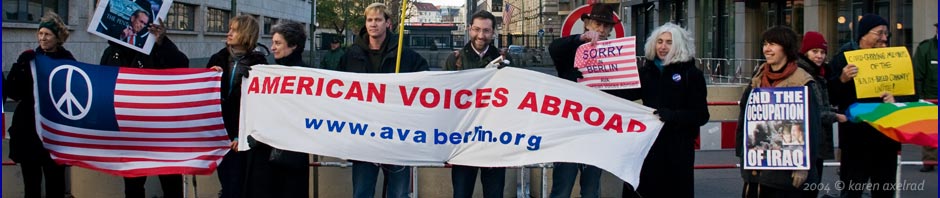
Our history: Two groups of anti-war Americans planning to march from opposite ends of Berlin’s biggest Iraq war demonstration on February 15, 2003, got wind of each other and arranged to meet in the middle. Needless to say, this proved to be an impossible endeavour in the crowd of 500,000 people—but find each other we did, if not that afternoon. Originally we called ourselves Americans in Berlin Against the War. Conversations and meetings then led to the creation of American Voices Abroad Berlin or AVA for short.
By now, over 20 years later, we can say that AVA offers the forum that we wanted and the community that grew out of it. We hope that you will join us at our Stammtisch on the first Thursday of every month, usually face-to-face but now and then via Zoom. There will be a lot to talk about and a lot of things to do in 2024.
—Ann Wertheimer, Chair, American Voices Abroad Berlin
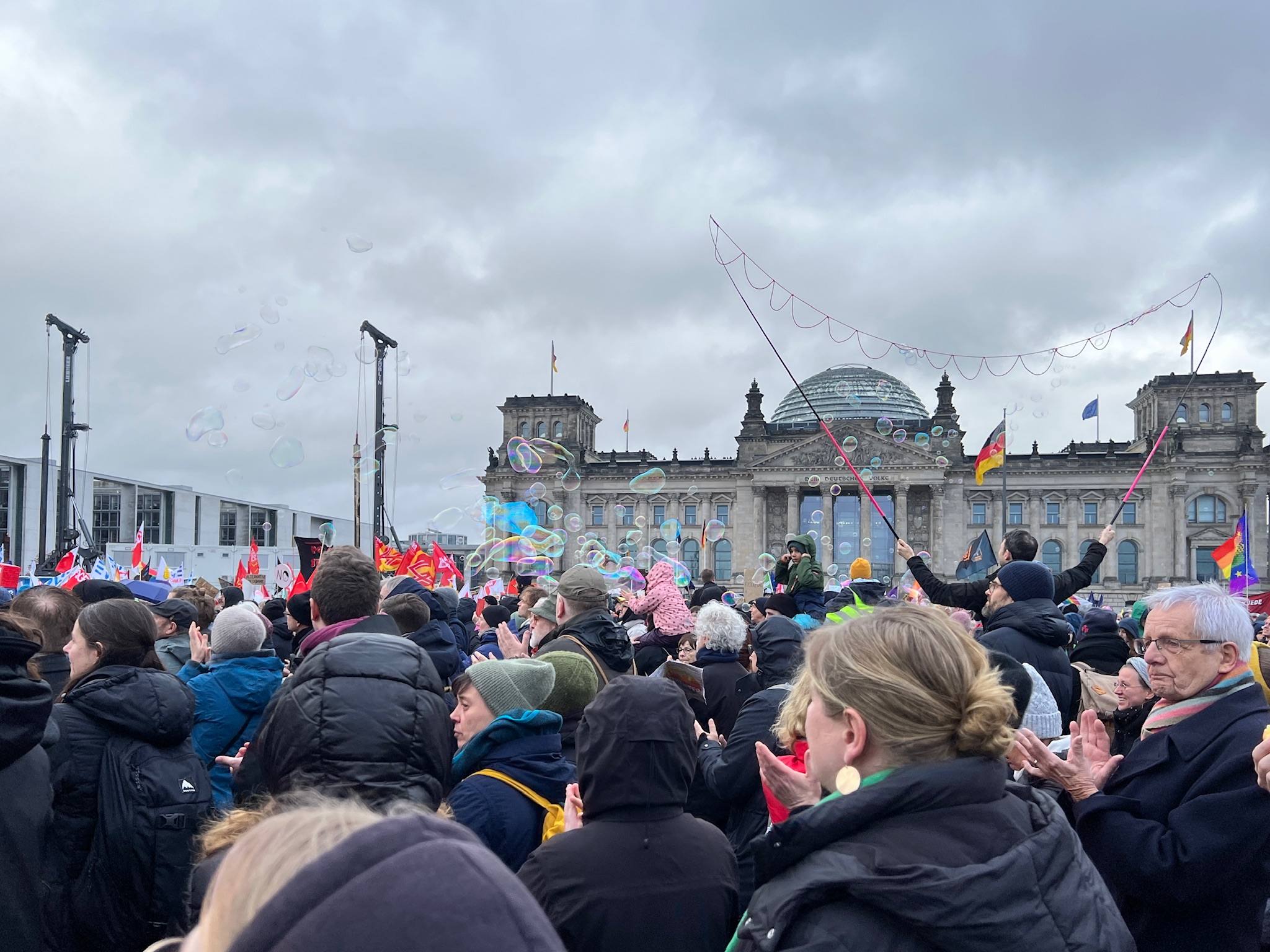
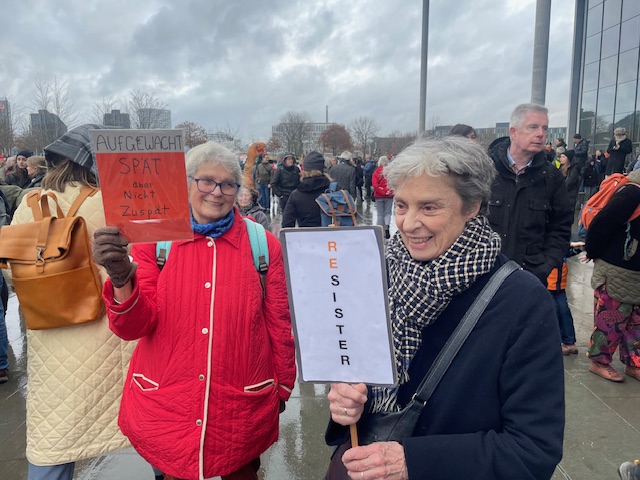

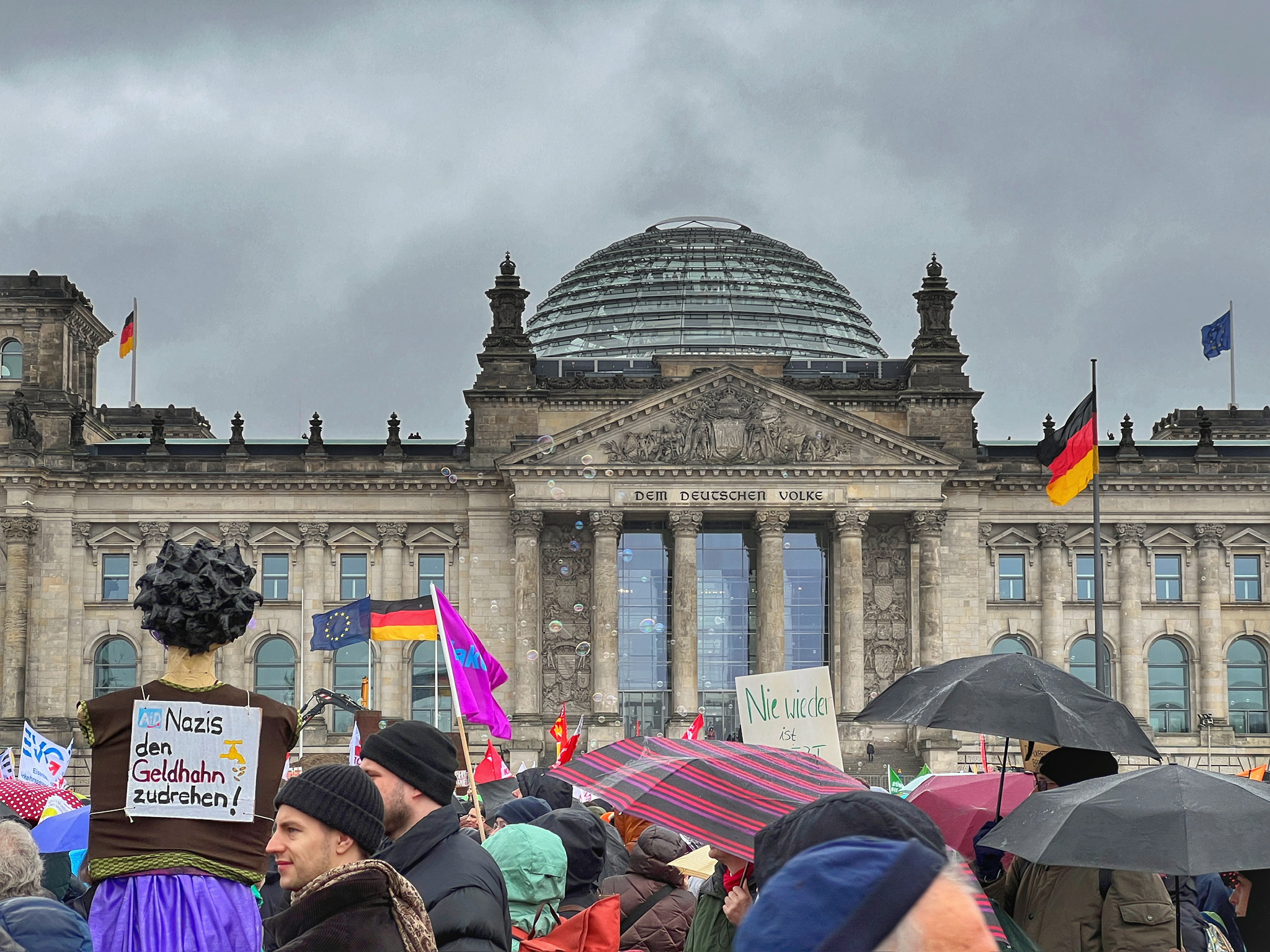
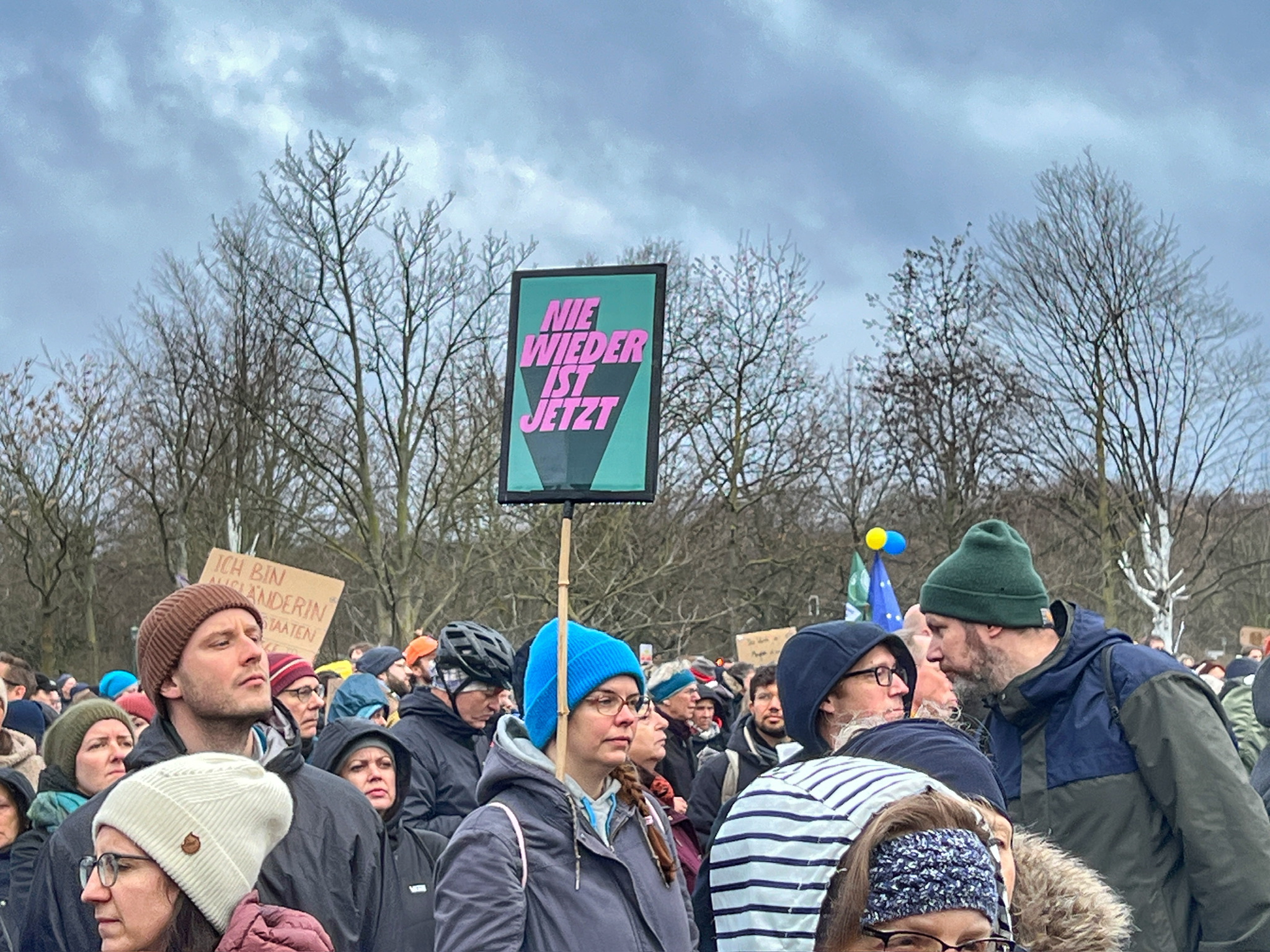
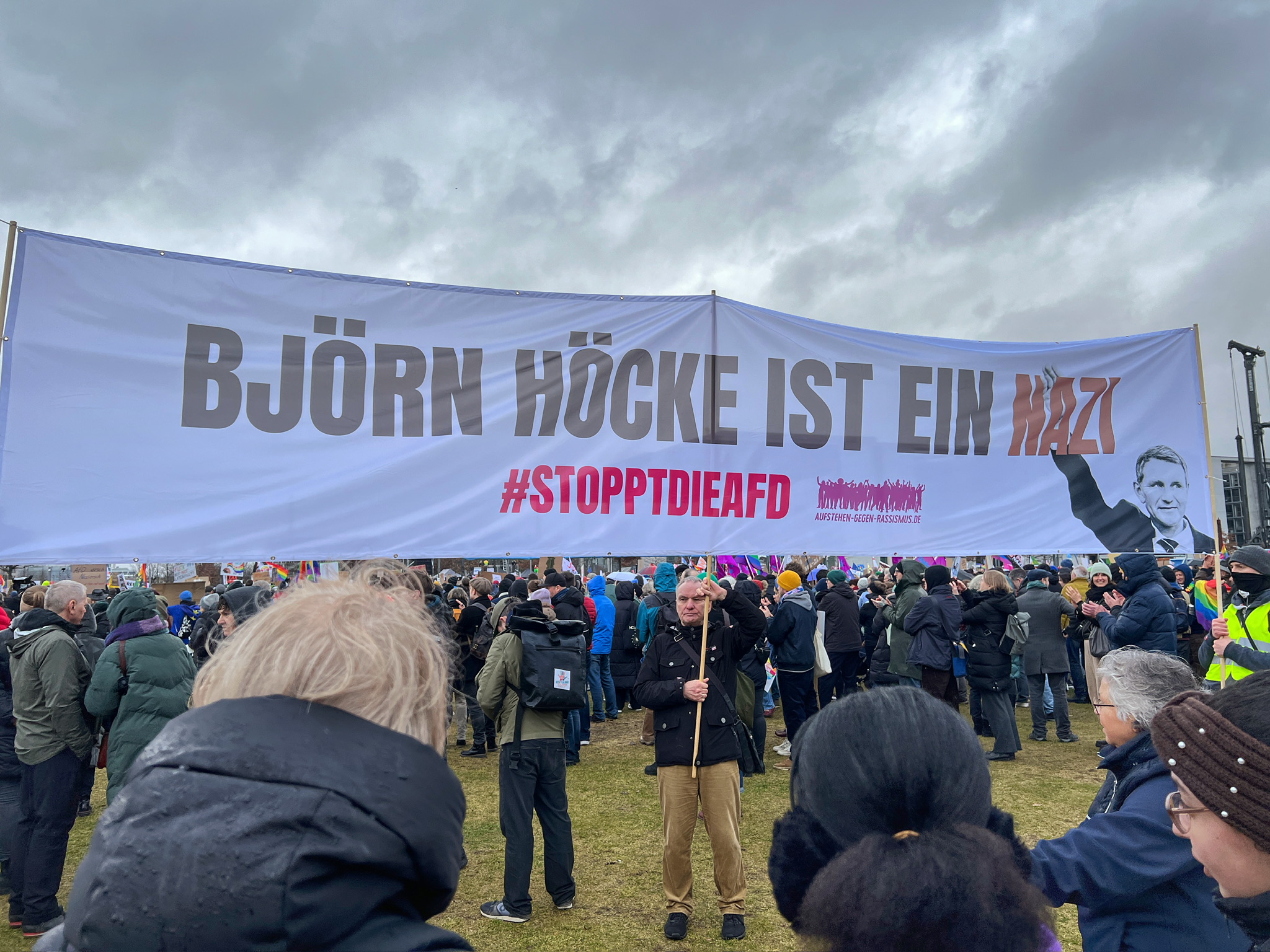
For solidarity and respect; against hate and aggression
For justice and tolerance; against division
For a society that leaves no one behind, for human dignity; against exclusion
For self-determination and humanity, for human rights for all; against racism, antisemitism, and other forms of group-based misanthropy
WHO WILL BE THERE: As of 3:30 p.m. on Wednesday, January 31, 2024, participating organizations numbered 1,352. Among them are GEW Berlin, Flüchtlingsrat Berlin, Chaos Computer Club, Seebrücke Berlin, Berliner Wassertisch, Verein Papageiensiedlung, Pro Asyl, Deutscher Caritasverband, Brot für die Welt, ver.di, Deutscher Mieterbund, Humanistische Union, Begine —Treffpunkt für Kultur für Frauen, Attac. Click on the link below for a full list.
FOR MORE INFORMATION: https://gemeinsam-hand-in-hand.org/
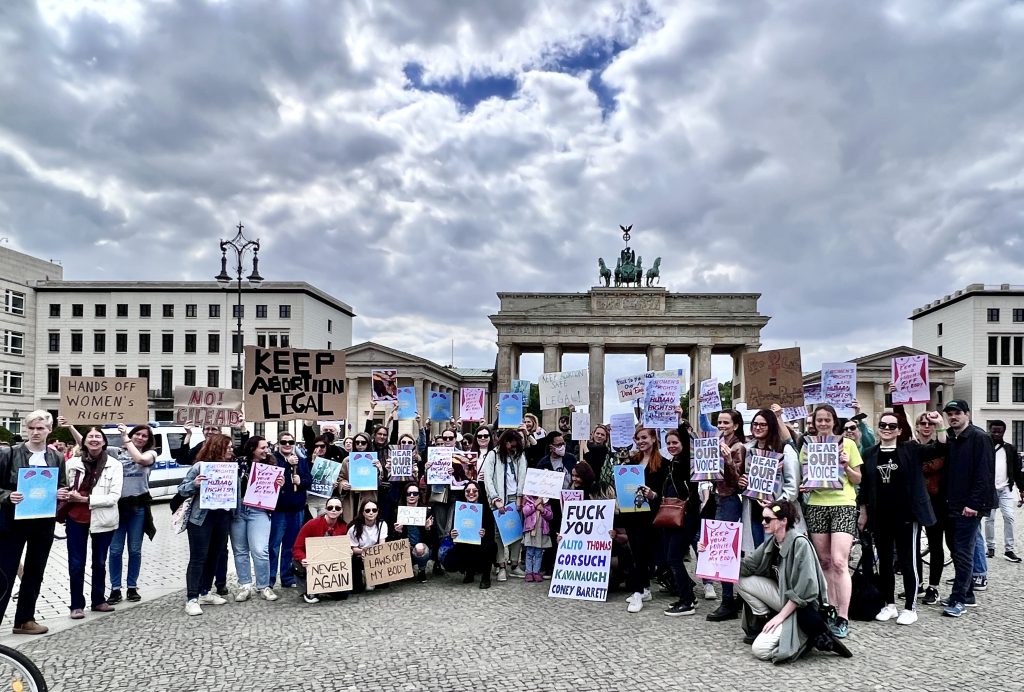
Responding to a recently leaked draft of a U.S. Supreme Court decision on the constitutional right to abortion, the Berlin section of Democrats Abroad organized a protest rally on May 14th at 2 p.m. at the U.S. Embassy. The leak indicated that a majority of the court plans to de facto abolish the right to abortion established almost 50 years ago by Roe versus Wade. AVA members joined Democrats Abroad Berlin to protest this decision, as thousands of people in cities all across America also gathered to stand up for reproductive justice, access to health care, and choice.
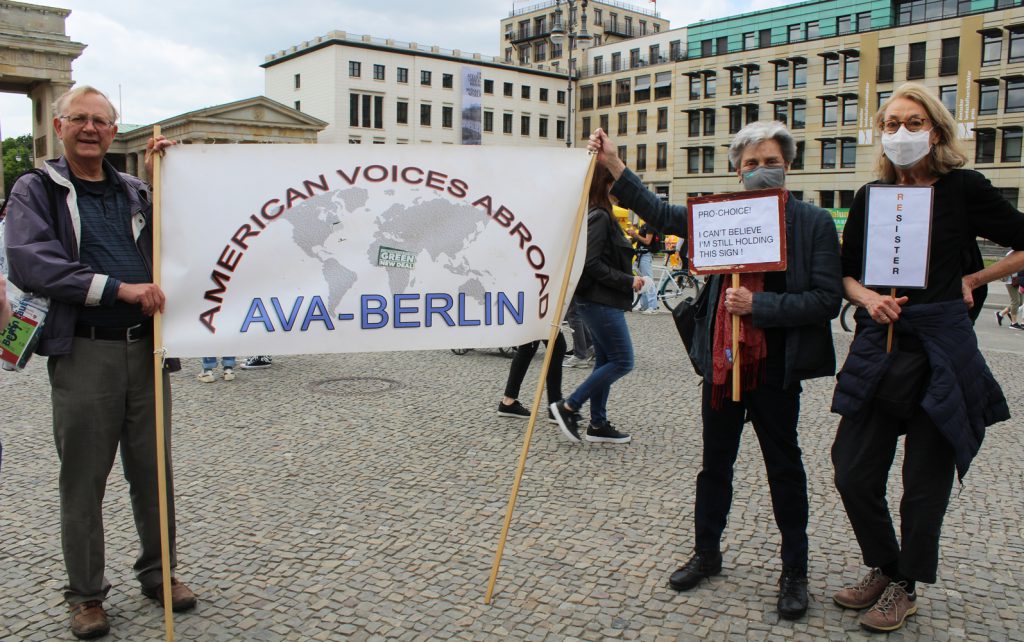
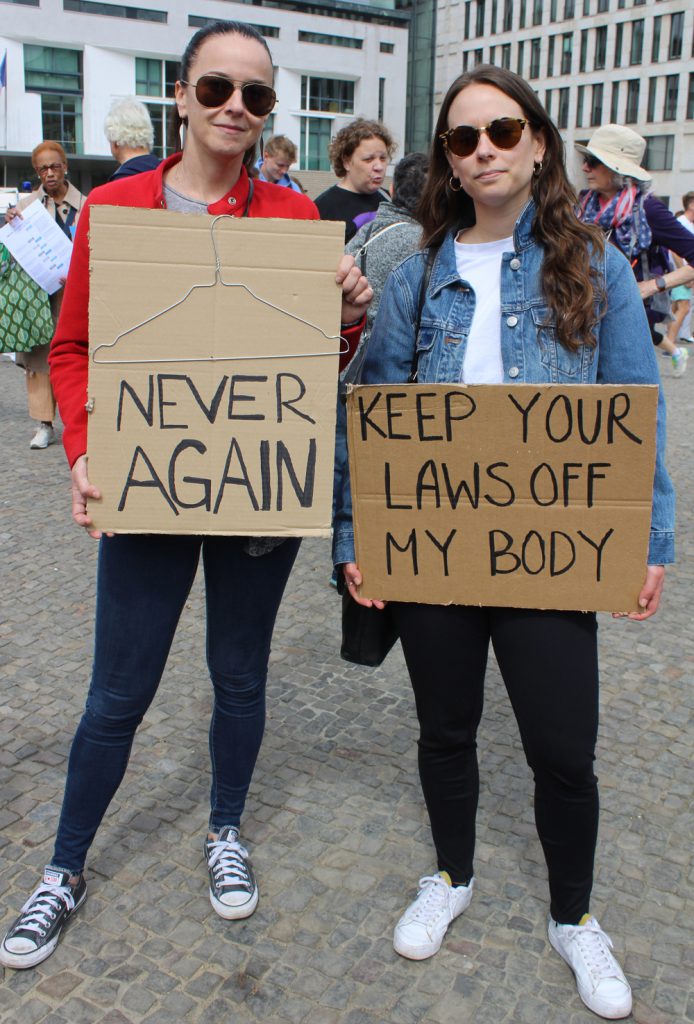
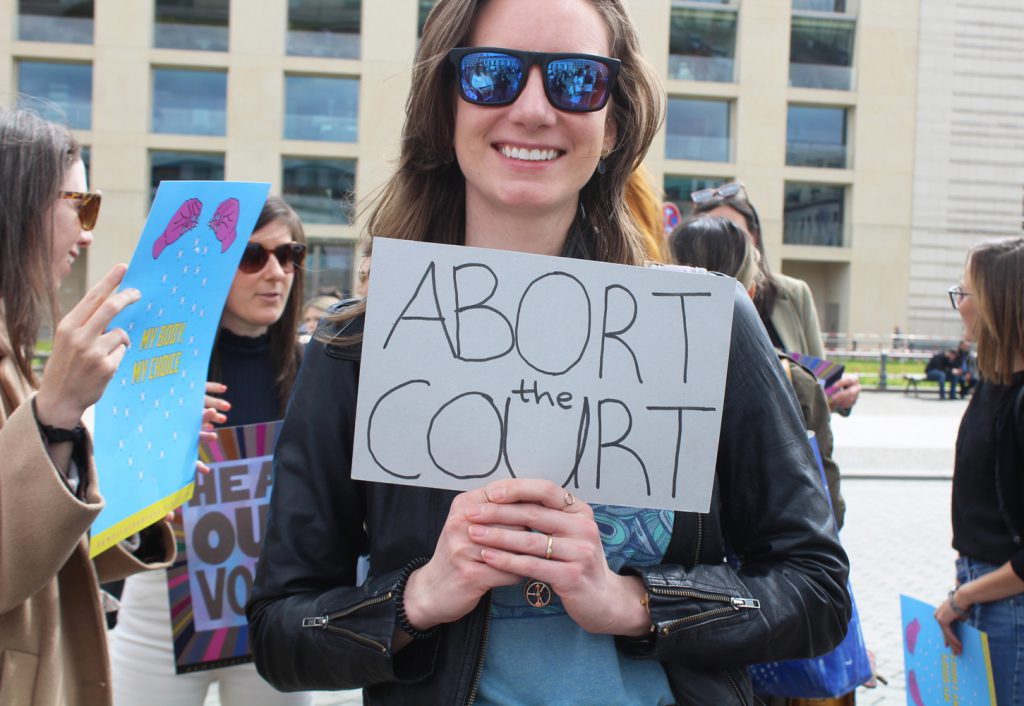
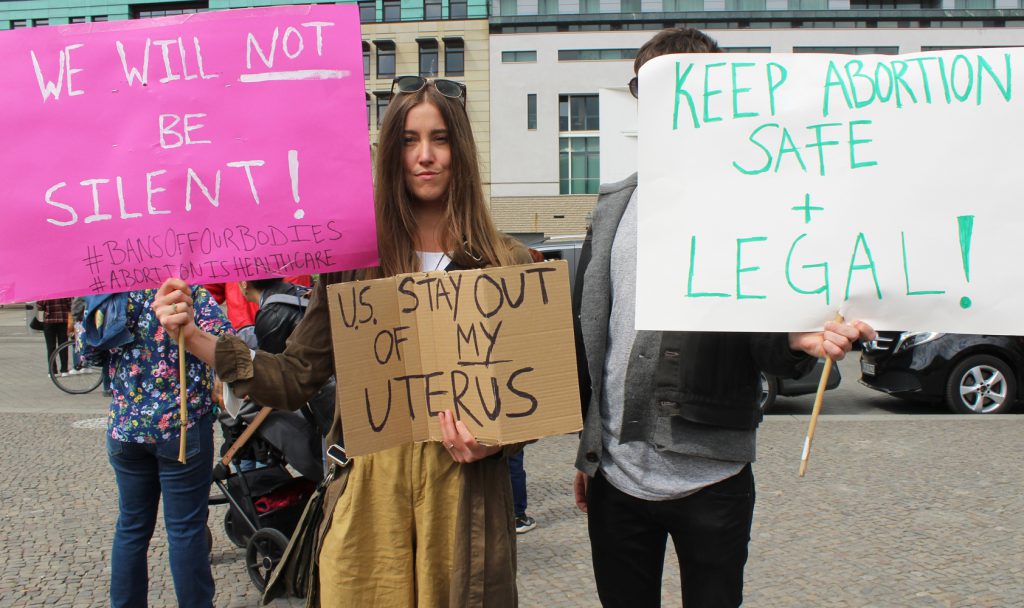
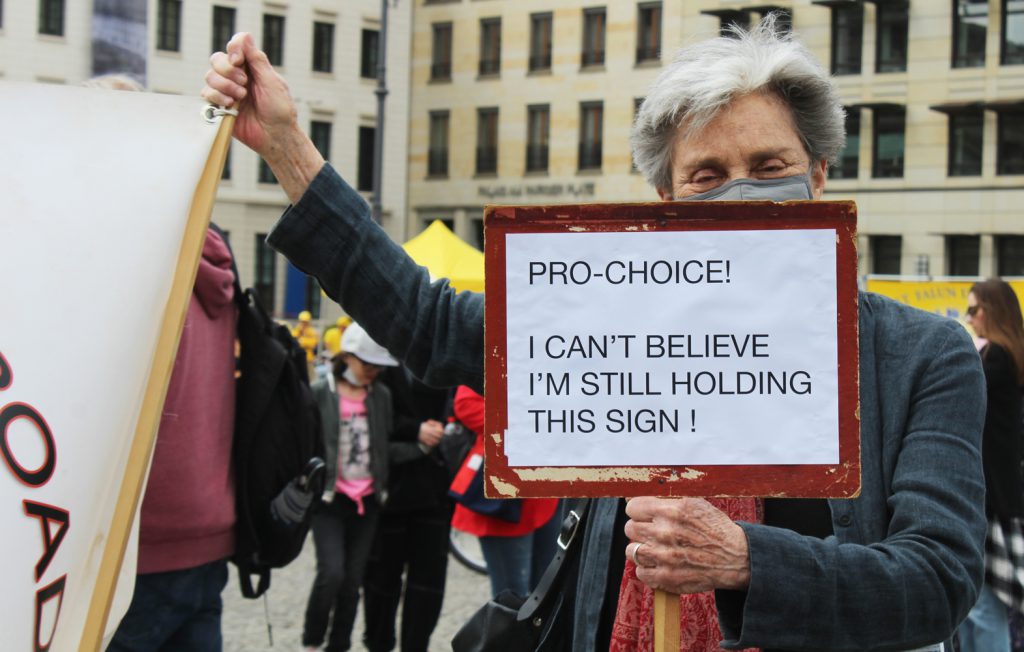
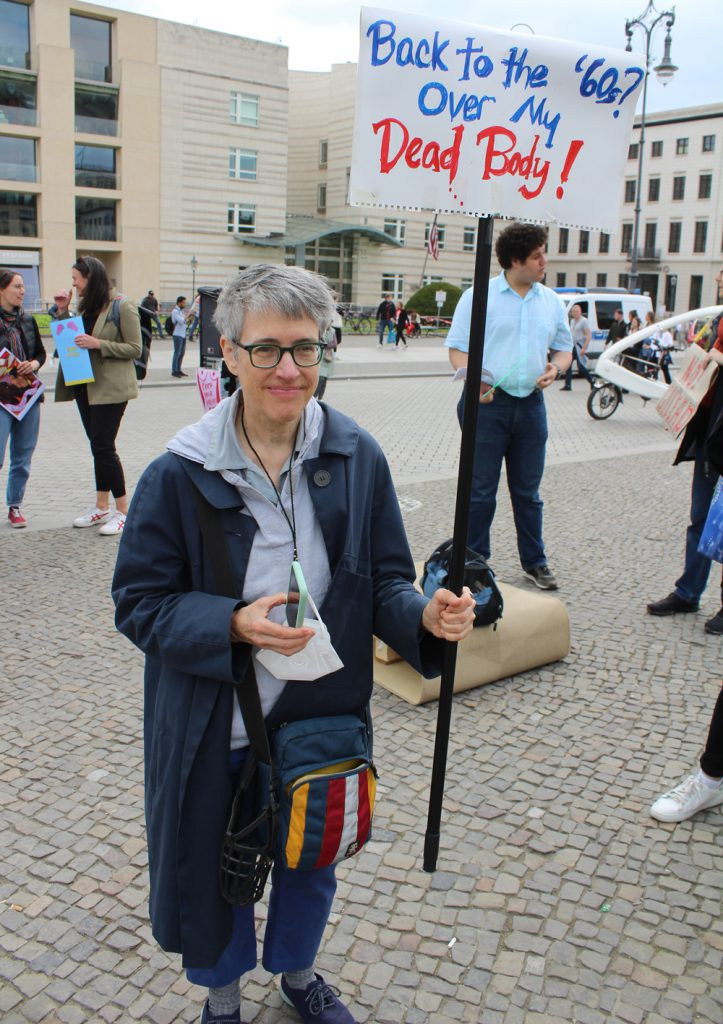
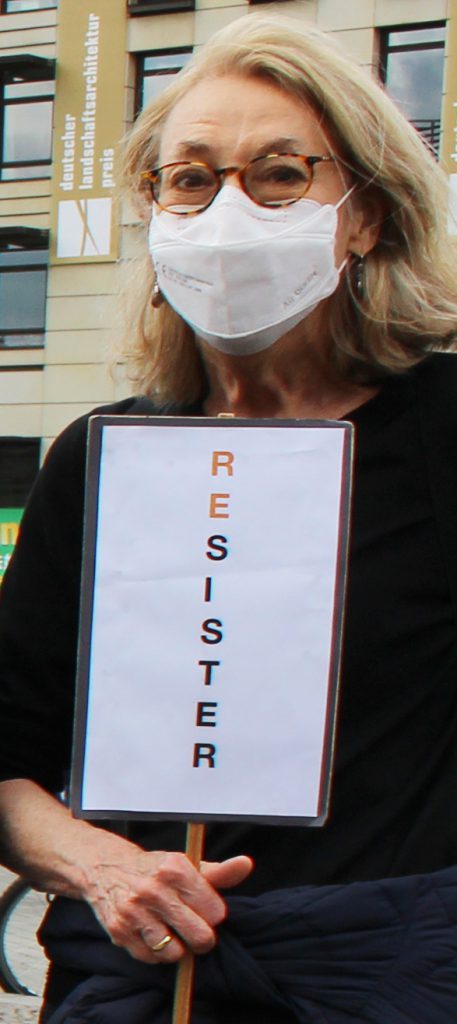
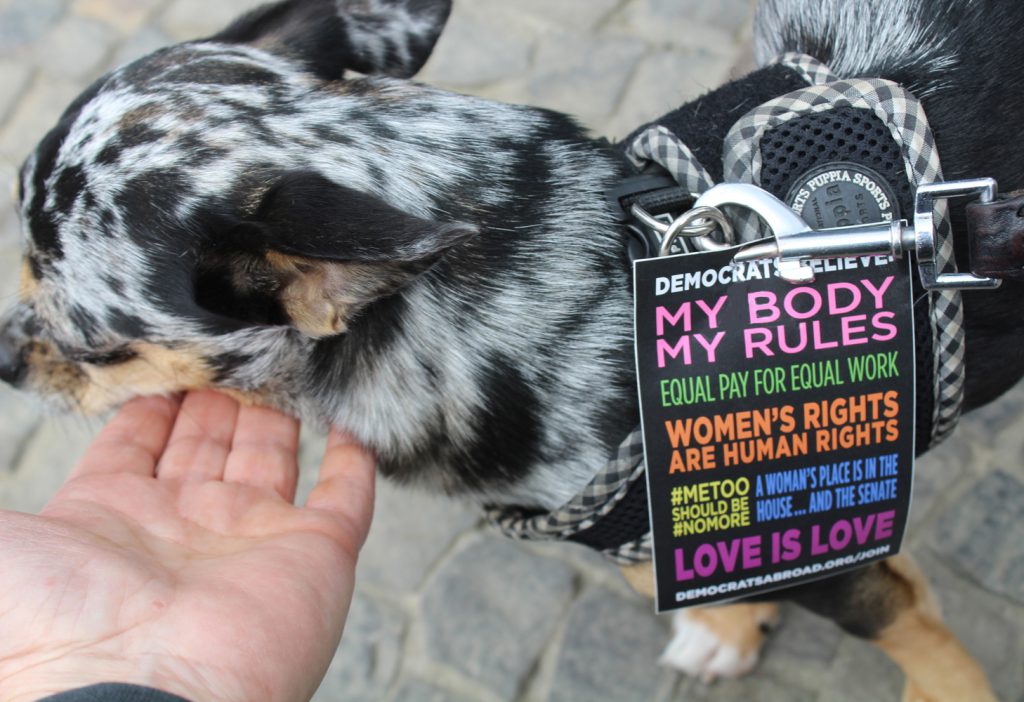
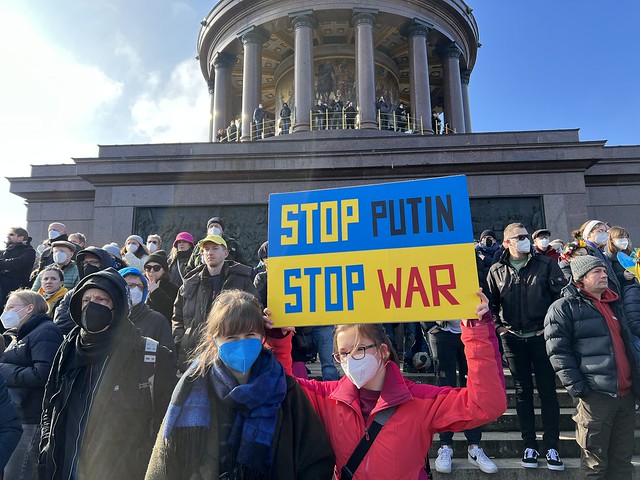
More Photos from Karen Axelrad here on Flickr: https://flic.kr/s/aHBqjzE5pR
Photos from Bonnie Woods on this page below: